Ghana is introducing a year-long testing program for digital assets, marking its first official move towards regulating and establishing crypto trading and services.
A Regulatory Crypto Sandbox
Ghana’s Securities and Exchange Commission (SEC) has launched a regulatory sandbox for companies working with virtual assets, like cryptocurrencies. According to Bloomberg, this framework, finalized on March 10th, will allow 11 pre-approved businesses to test their products and services in a safe, monitored environment overseen by the SEC. This initiative is based on Ghana’s new Virtual Asset Service Providers Act of 2025 (Act 1154), which provides the legal foundation for regulating and licensing crypto businesses.
How The Sandbox Will Work
The new program will run for a year, allowing a select group of approved cryptocurrency companies to offer their services to users while being closely monitored by regulators. After six months, companies that are prepared and meet all requirements can apply for full operating licenses. Others can continue testing their services for the remaining six months.
What It Means For Regulators
As a researcher studying regulatory innovation, I’ve found that regulators often view ‘sandboxes’ as a valuable tool. Essentially, they allow for the encouragement of new ideas and technologies without compromising essential priorities like protecting investors, maintaining a fair and honest market, and upholding anti-money laundering and counter-terrorism financing standards. The regulator themselves explained it this way in their recent announcement:
This trial period is designed to encourage new ideas in a safe way, while also protecting investors, maintaining fair markets, and preventing financial crime like money laundering and the funding of terrorism.
Rather than just relying on predictions or what companies say, regulators can use a testing program to collect actual data on how investors behave, how well platforms handle stress, and the risks of market manipulation. This pilot program will also let the SEC finalize specific rules for different types of virtual asset service providers, as outlined in the 2025 Act (Act 1154), before fully launching the new system. According to the announcement, the insights gained from this program will shape future policies and licensing requirements for virtual assets.
The SEC can address problems like security breaches, misleading sales practices, or cash flow issues more efficiently by initially working with a select and trusted group. This allows them to refine regulations and technical standards before issuing full licenses.
What It Means For Participants
The SEC announced the 11 companies selected for its pilot program. These firms offer a range of services, including tokenization, crypto custody, and exchange platforms. One example is WhiteBit, a centralized exchange that allows users to trade cryptocurrencies, hold their assets, and convert between traditional money and crypto.
The eleven participants will follow specific rules regarding risk, transparency, and legal compliance. This allows the regulator to carefully study how their approaches to trading, holding, and creating digital tokens work in a real-world setting. Those who succeed in this program will serve as examples of best practices for all licensed virtual asset service providers.
The 12-month trial period will determine whether these companies can obtain full licenses. Success during this time means they’ll be able to operate in Ghana’s regulated market when the new rules are fully implemented, but failure could result in them being excluded.
Ghana In The African Crypto Context
Several African nations are developing new laws and testing environments for cryptocurrency. Ghana is the latest to join countries like Zambia in using technology to monitor crypto services before they become widely available, showing a growing trend across Africa towards this cautious approach. Ghana, a major gold-producing country, is experiencing a surge in cryptocurrency adoption, with reports indicating millions of adults are already trading it. The country’s central bank has also been drafting regulations to bring the crypto sector into a more formal, regulated system.
If the testing phase shows reliable data and few problems, Ghana could quickly move towards fully regulating cryptocurrency exchanges and platforms that handle tokenization.
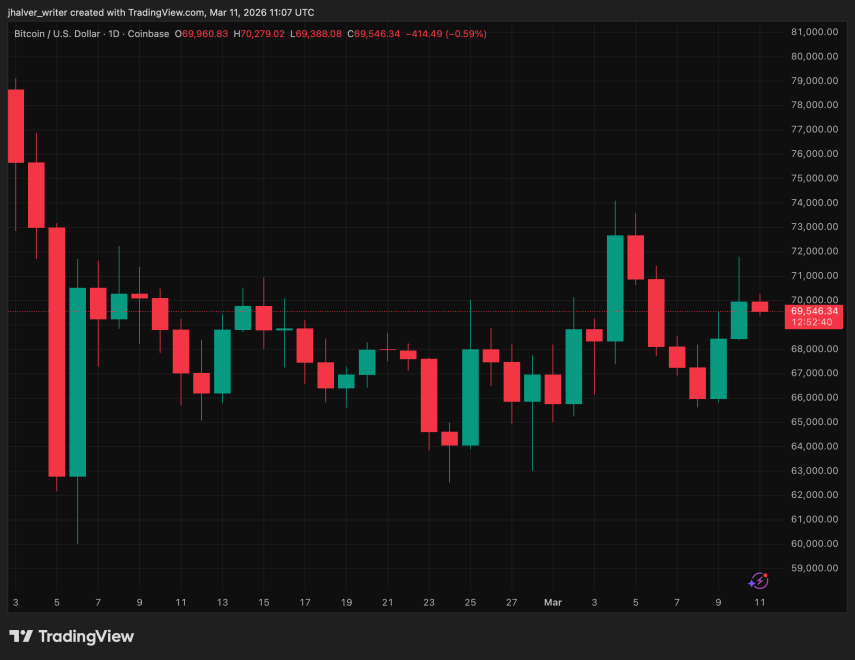
Cover image from Perplexity, BTCUSD chart from Tradingview
Read More
- Gold Rate Forecast
- Brent Oil Forecast
- OKB PREDICTION. OKB cryptocurrency
- Chainlink Soars, BNB Chain Joins the Party! What’s Next for LINK?
- USD GEL PREDICTION
- Is Bitcoin Done Or Is This Just The Beginning? Pundit Shares Points To Consider
- SOL’s Sky-High Gambit: ETF Dreams or a Crypto Mirage?
- Bitcoin’s Dramatic Fall Puts Strategy’s Holdings in Crisis Mode! What Happens Next?
- Silver Rate Forecast
- SUI PREDICTION. SUI cryptocurrency
2026-03-11 17:13