Oh, how the world has changed! From London to Brazil, governments have been busy this week, tightening their grip on iGaming with tax hikes, sponsorship bans, and enforcement drives. How very… orderly.
A Week of Wonders: Taxes, Bans, and Crackdowns That Will Make You Question Life Itself
Here’s a jurisdiction-by-jurisdiction breakdown of the most consequential moves. Prepare your tea, your patience, and your sense of irony.
X Restricts Gambling Paid Partnerships
In February 2026, the social media platform X updated its Paid Partnerships policy to prohibit gambling promotions through compensated influencer deals, affiliate arrangements, and ambassador programs. While licensed operators can still purchase formal ads in jurisdictions where gambling is permitted, the door has effectively closed on organic “paid partnership” posts tied to referral links and promo codes. A move so subtle, it’s like a whisper in a library. But don’t worry, they’ve still got ads for you to click on, if you’re in a permitted jurisdiction.
The change, implemented without a major public announcement, places gambling alongside other restricted categories such as alcohol and financial services. Industry sources say affiliates who relied on “link in bio” strategies face abrupt disruption, as violations could result in content removal or account suspensions. For brands, that means shifting marketing budgets toward regulated ad channels or exploring alternative acquisition funnels. A delightful conundrum, no?
UK Targets Unlicensed Sponsorships
On Feb. 23, 2026, the UK Department for Culture, Media and Sport announced plans to prohibit unlicensed gambling operators from sponsoring British sports teams, including those in the Premier League. The proposal directly affects arrangements such as Stake’s partnership with Everton and responds to concerns that offshore operators lack compliance with Gambling Commission standards.
Culture Secretary Lisa Nandy said: “It’s not right that unlicensed operators can sponsor our biggest football clubs.” A consultation is set for spring 2026, and while existing agreements may be honored, new sponsorships by unlicensed entities would be restricted. The measure expands on the Premier League’s voluntary decision to phase out front-of-shirt gambling sponsors after the 2025-26 season, extending scrutiny to sleeve deals and other branding placements. A noble cause, or just a way to keep the clubs’ jerseys free of “unseemly” ads?
UKGC Licence Fees Could Rise by 30%
The UK is also weighing a financial squeeze on operators. A consultation launched Jan. 28, 2026, proposes increasing UK Gambling Commission licence fees by 20% to 30% to fund enforcement, illegal market disruption, and commitments tied to the Gambling Act Review.
Three models are under consideration, including a flat 30% increase preferred by the regulator. The consultation runs through March 29, 2026, with potential implementation by Oct. 1, 2026. Officials estimate the changes could generate roughly £8 million in additional annual costs for the industry, aimed at stabilizing the regulator’s finances as reserves diminish. A tax on the tax, if you will.
Brazil’s Deposit Tax Sparks Alarm
Brazil’s regulatory agenda is equally ambitious. The Senate plenary approved an antifaction bill on Dec. 10, 2025, introducing a proposed 15% CIDE-Bets tax on player deposits to licensed platforms. However, amendments pushed a final vote into 2026, returning the measure to the Chamber of Deputies.
Industry groups warn that taxing deposits rather than revenue could widen the illegal market, already estimated to account for 51% of activity. Analysts caution that channelization – the share of players using licensed platforms – could dip below 20% if costs become prohibitive. Meanwhile, a separate law signed Jan. 4, 2026, gradually raises gross gaming revenue taxes from 12% to 15% by 2028, alongside tighter advertising controls. A tax on taxes, and then some.
EU Proposal for a Unified Gambling Levy
At the European level, Romanian MEP Victor Negrescu floated the idea of a harmonized EU-wide levy on online gambling profits during a Feb. 19, 2026, plenary discussion. He suggested such a measure could raise €2 billion to €4 billion annually for education, addiction treatment, and mental health programs.
Trade associations, including the European Gaming and Betting Association, argue the plan lacks a clear legal basis and could complicate national frameworks. No formal bill has been introduced, but the debate reflects a growing appetite for cross-border coordination in a sector traditionally regulated at the national level. A grand European union, but for taxes, not for peace.
Cambodia Revokes Casino Licences
In Southeast Asia, enforcement actions intensified. On Feb. 13, 2026, Cambodia’s Commercial Gambling Management Commission revoked licences for five casinos allegedly tied to Chen Zhi, extradited to China in January 2026 over cyber-fraud allegations. A sixth venue was suspended.
The casinos, located in Sihanoukville and other provinces, were accused of violating the Commercial Gambling Management Law and being linked to scams, forced labor, and money laundering. Authorities have shuttered 190 scam operations in early 2026 and imposed mandatory annual audits, signaling a sustained purge of crime-linked activity. A dramatic exit for the unscrupulous.
Virginia Moves Toward Legal Online Casinos
In the United States, Virginia’s legislature advanced SB 118 and HB 161 to legalize online casinos under the oversight of the Virginia Lottery. The Senate version envisions a July 1, 2027, launch, while the House measure requires reapproval in 2027 for a 2028 rollout.
The bills set a 20% tax on adjusted gross revenue, plus a 6% economic development fee benefiting land-based casinos. Lawmakers estimate the state’s unregulated iGaming market at roughly $12 billion, with projections of $240 million in net revenue by 2028. Supporters argue that legalization would redirect players from offshore sites, while critics raise addiction concerns. A noble goal, if only the addicts weren’t already addicted.
Malaysia and Thailand Confront Youth Gambling
Malaysia’s Malaysian Communications and Multimedia Commission removed 15,519 gambling-related content items during the first 15 days of 2026, part of broader efforts to combat online scams. Since 2022, more than 224,000 gambling posts have been taken down, with social media platforms cooperating on enforcement.
In Thailand, a 2025 Center for Gambling Studies report found 32.3% of individuals aged 15 to 25 engaged in gambling, totaling 2.9 million young people. Transactions among that group exceeded 58.6 billion baht, and 739,000 were deemed at high risk of addiction. Youth advocacy groups have petitioned against the legalization of casino complexes, citing escalating exposure. A generation of gamblers, one click at a time.
Kenya Pauses Licences During Regulator Transition
Kenya is undergoing structural reform. The Betting Control and Licensing Board will dissolve effective Feb. 28, 2026, replaced by the Gambling Regulatory Authority under the Gambling Control Act, 2025. All new and renewal licence applications are suspended during the transition.
Existing operators may continue under current terms until expiry. Authorities say the new regulator will emphasize real-time monitoring, stronger compliance standards, and alignment with international best practices. A new era of oversight, or just a bureaucratic shuffle?
A Global Pattern Emerges
Taken together, these measures reveal a consistent theme: governments are pressing for tighter oversight while seeking to maximize tax revenue. From the UK’s fee consultations to Brazil’s layered tax approach and Virginia’s legalization push, fiscal considerations sit alongside consumer protection and anti-crime objectives. A world where every action is a tax, and every tax is a story.
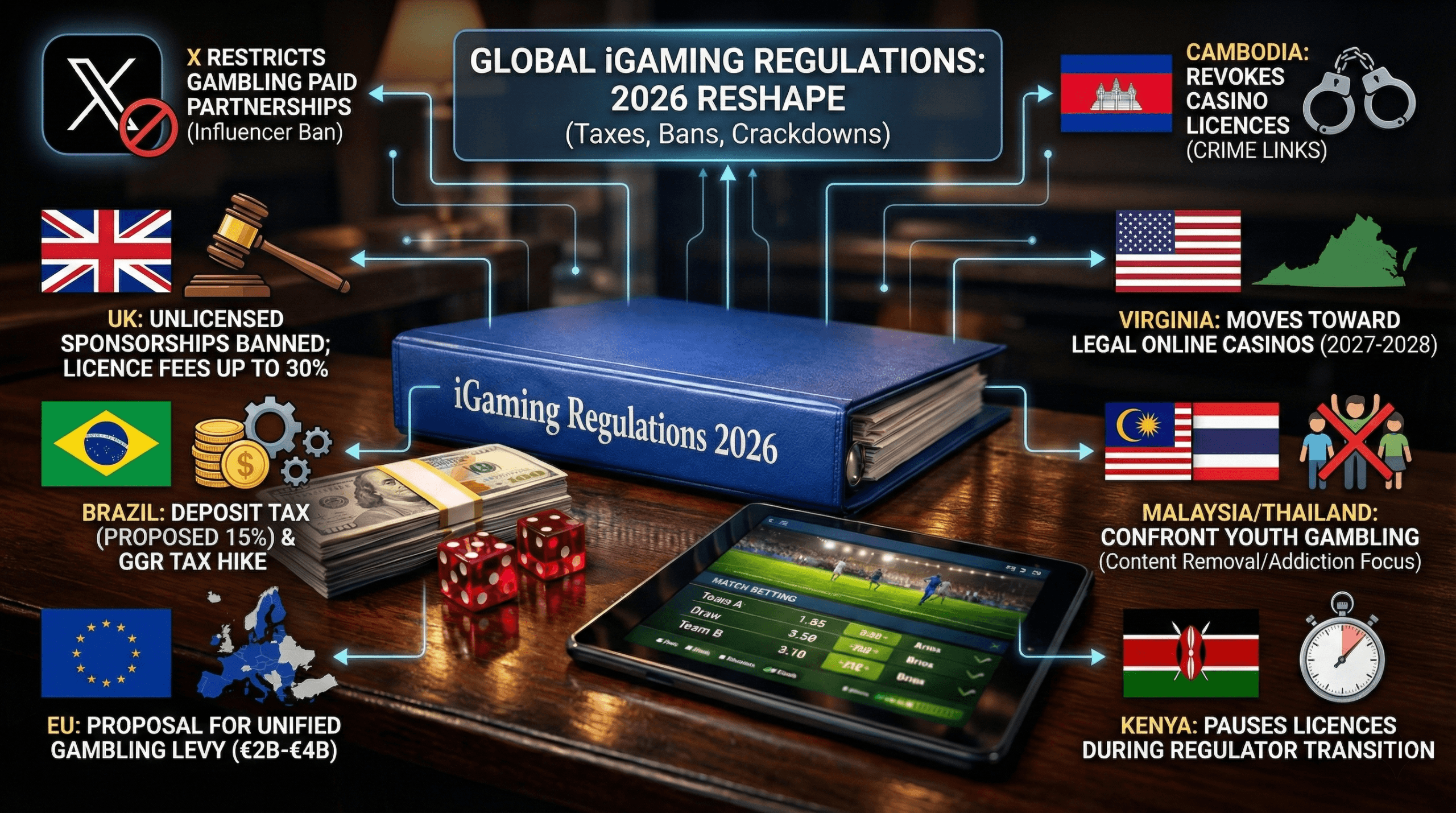
The friction lies in calibration. Industry groups warn that excessive taxation or advertising restrictions could fuel black markets, while policymakers argue that stronger enforcement and education funding are essential safeguards. As 2026 unfolds, consultations, legislative votes, and regulatory transitions will determine how balanced that equation becomes. A dance of regulation, where the steps are both elegant and absurd.
FAQ 🔎
- Why did X ban gambling paid partnerships?
X restricted compensated influencer gambling promotions to limit organic reach for betting brands while still permitting formal ads in compliant jurisdictions. A delicate balance, indeed. - What is Brazil’s proposed deposit tax?
Brazil is considering a 15% tax on player deposits to licensed platforms, alongside phased increases in gross gaming revenue taxes through 2028. A tax so bold, it’s like a siren song luring players into the arms of the state. - How much could UK licence fees increase?
UK Gambling Commission operating licence fees could rise by up to 30%, with consultation open until March 29, 2026. A financial squeeze that’s as gentle as a feather, but as heavy as a brick. - When could Virginia launch legal online casinos?
Virginia’s legislation outlines a potential launch between 2027 and 2028, pending final approval and implementation steps. A delay that’s as long as a politician’s promise.
Read More
- Gold Rate Forecast
- Brent Oil Forecast
- Silver Rate Forecast
- STX PREDICTION. STX cryptocurrency
- Bitcoin’s $90K Dream: A Tale of Technical Traps 📉💥
- CNY JPY PREDICTION
- DOGE PREDICTION. DOGE cryptocurrency
- BNB’s Big Gamble: $160M Bet or Just Another Rich Kid’s Allowance? 💸🚀
- 🚀 Solana’s November: Bull Run or Bull Plop? 🌽
- 🤯 $40 Billion?! Tech’s AI Obsession is REAL.
2026-02-24 19:37