The newest AI breakthrough wasn’t developed by a large organization, but rather by AI researcher Andrej Karpathy during a weekend project. He created a system to assess how likely different U.S. jobs are to be replaced by automation.
Nearly 60 Million U.S. Jobs Flagged as Highly Exposed in Karpathy’s AI Automation Map
Andrej Karpathy, a co-founder of OpenAI and former Tesla artificial intelligence (AI) director, released an interactive “AI Job Exposure Map” on March 15, analyzing 342 occupations drawn from the U.S. Bureau of Labor Statistics (BLS) Occupational Outlook Handbook.
The project analyzed around 143 million U.S. jobs by using AI to assess how much each role could be changed by automation. The AI reviewed job descriptions and gave each job an ‘exposure score’ from 0 to 10, indicating the potential for AI to reshape the work involved.
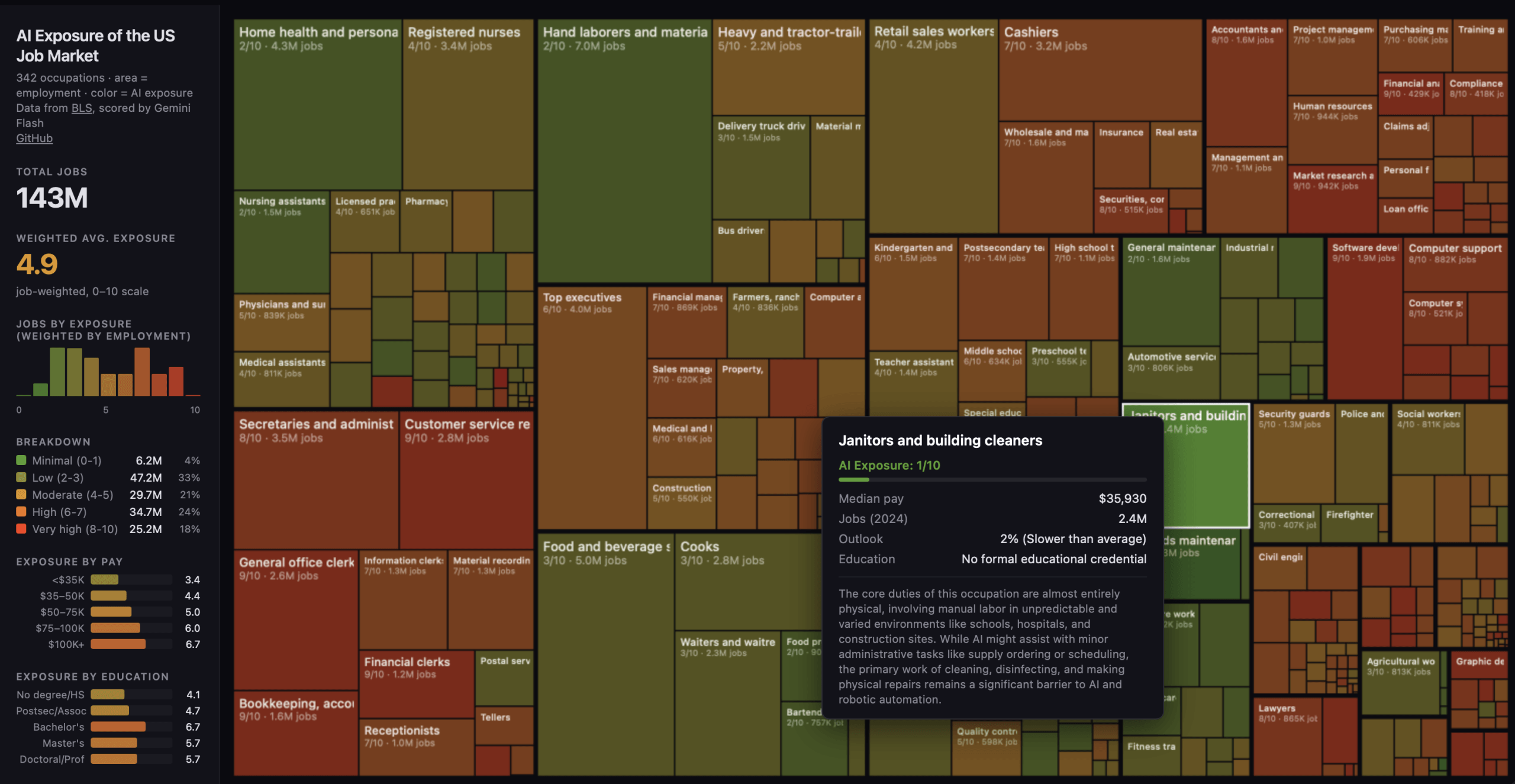
We visualized the job market data using a colorful chart at karpathy.ai/jobs. The size of each rectangle showed how many jobs were available in that field, and its color indicated how likely those jobs were to be affected by automation – green meant low risk, while dark red signaled high risk. Essentially, larger and redder rectangles highlighted the jobs needing the most attention.
Overall, AI has a moderate potential to impact U.S. jobs, with an average exposure score of around 4.9 out of 10. However, this average doesn’t tell the whole story. A significant portion of American jobs – around 42%, representing nearly 60 million workers and $3.7 trillion in wages – face a high level of AI influence, scoring seven or higher on the exposure scale.
Looking closer at the numbers, approximately 6.2 million jobs have very little risk, and 47.2 million have low risk. Around 29.7 million jobs face moderate risk. However, the most significant numbers are at the higher end: about 34.7 million jobs are considered high risk, and 25.2 million are very high risk.
Interestingly, Andrej Karpathy’s research revealed a surprising connection between salary and the potential for AI impact. Jobs earning less than $35,000 a year had a relatively low exposure to AI (around 3.4), while those paying over $100,000 had a much higher exposure (6.7). This suggests that higher-paying jobs are more likely to include tasks that AI can currently handle or help with.
Educational background also followed a clear trend. Workers without a college degree had an average exposure score of around 4.1. Those with a bachelor’s degree had the highest score, averaging about 6.7. People with advanced degrees fell in between, with an average score of approximately 5.7.
When we look at specific jobs, the trend becomes even clearer. Medical transcriptionists received a perfect score of 10, showing that speech recognition and automated systems are already handling much of their work. Lawyers, accountants, financial analysts, and management consultants generally scored around nine, mainly because their jobs heavily involve organized information, documents, and research.
Software developers—ironically the people building many AI tools—also ranked high, often scoring between eight and nine. Meanwhile, roles such as administrative assistants, bookkeeping clerks and customer service representatives showed similarly elevated exposure levels due to their reliance on digital workflows.
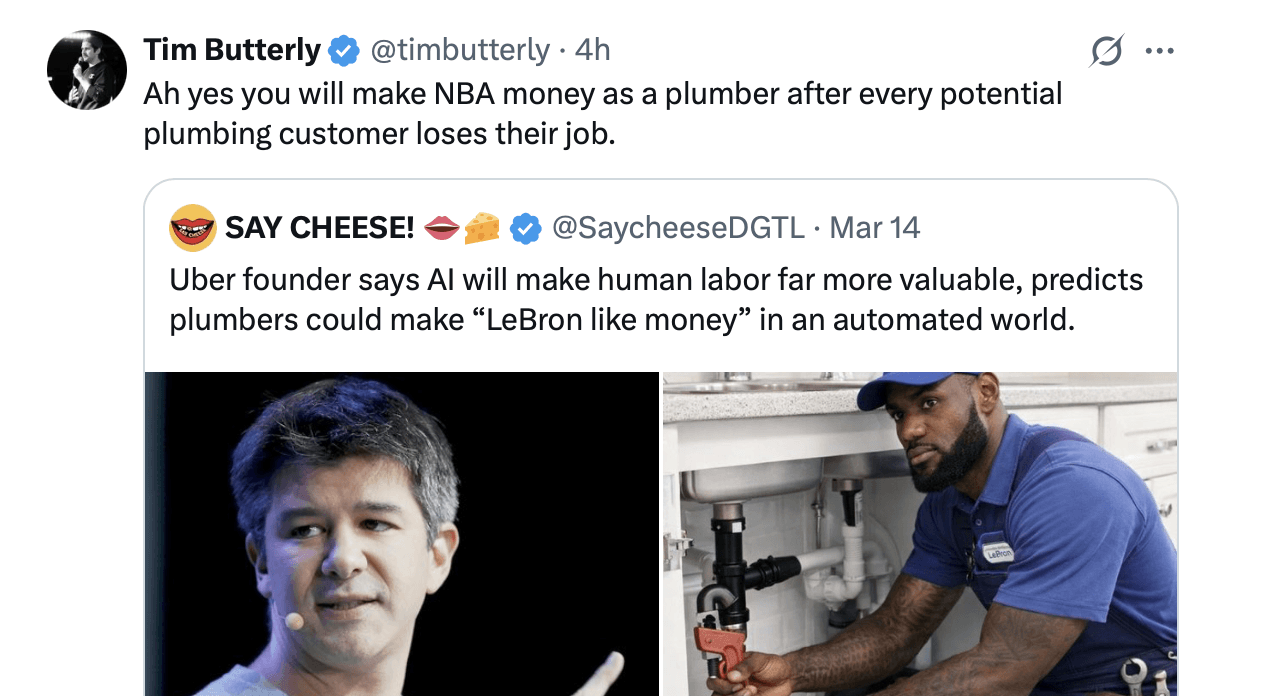
Jobs that involve working with your hands – like plumbing, electrical work, and construction – proved much more secure. These roles generally received low automation risk scores, between zero and two, because they require dealing with unpredictable, real-world situations that are hard to automate.
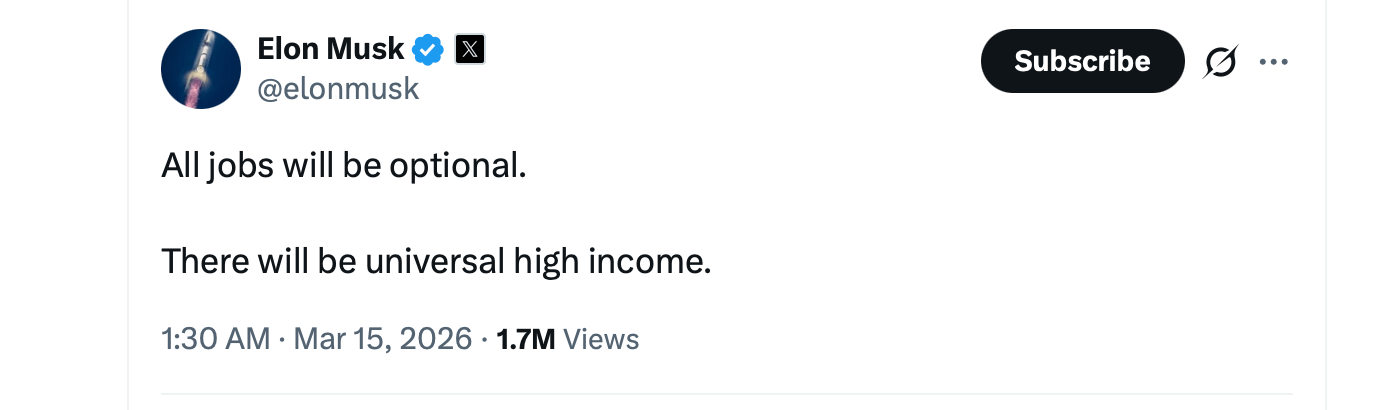
The map’s rapid spread online triggered commentary across the technology world, including a brief response from Tesla and SpaceX CEO Elon Musk. Replying to a thread about the visualization, Musk wrote: “All jobs will be optional. There will be universal high income.”
The comment repeated Elon Musk’s frequent point that powerful AI and robots could one day create so much wealth that people wouldn’t need to rely on regular jobs as much.
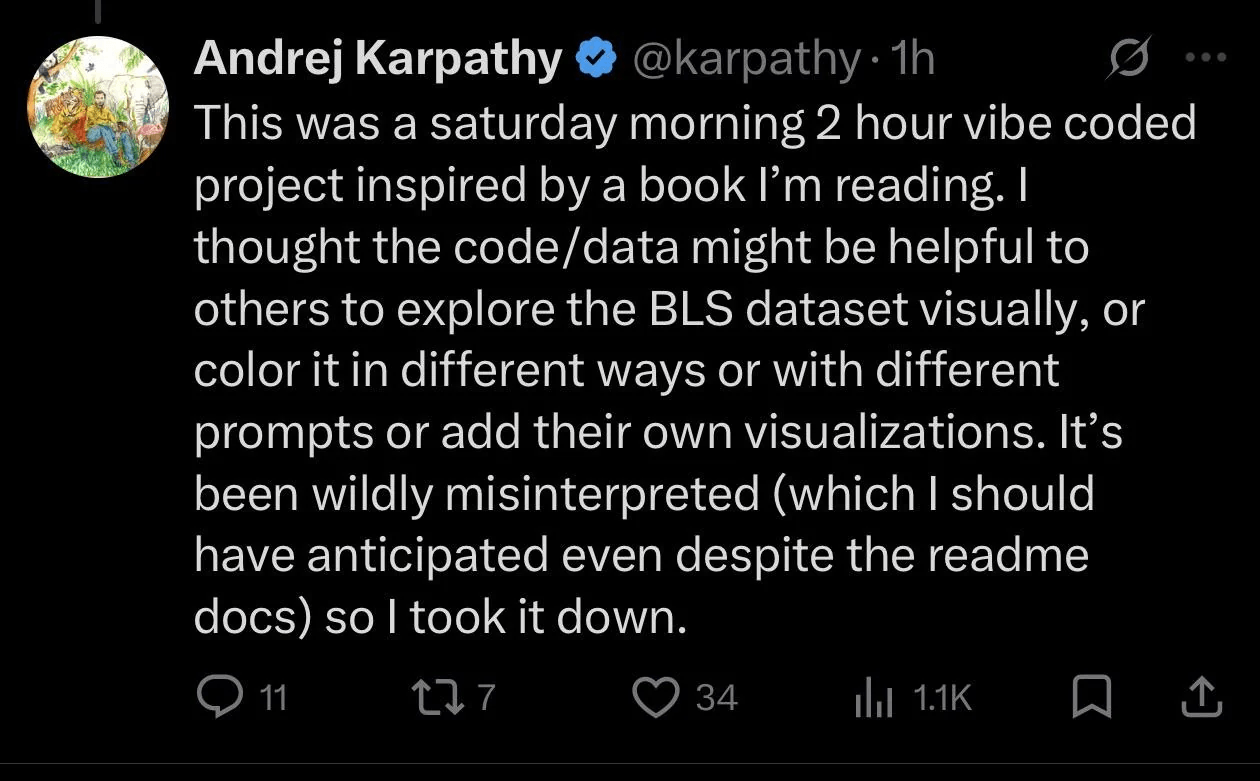
Even though it gained a lot of attention, Andrej Karpathy quickly took down the initial website and its code repository. He explained in a later post that the project was just a quick experiment—something he called a two-hour exploration sparked by a book he’d been reading. Karpathy felt that people misinterpreted the project’s experimental nature, despite his clear warnings that it wasn’t meant to be anything more.
Taking the site down did little to slow its spread. Archived copies appeared almost immediately on the Wayback Machine, and the code repository was forked numerous times by developers who replicated the dataset, scoring rubric, and visualization tools.
This recent event highlights two key points about the internet today: breakthroughs in AI can quickly become worldwide discussions, and information shared online tends to stay there permanently. Currently, Karpathy’s project is more of a look at how AI and human work connect, rather than a prediction of widespread job losses.
Simply put, the main point is this: if you do all your work on a computer, artificial intelligence will likely become either a helpful assistant or a strong rival in the near future.
FAQ 🔎
- What is Andrej Karpathy’s AI Job Exposure Map?
It is a visualization analyzing 342 U.S. occupations and scoring how susceptible each job may be to AI automation. - How many U.S. jobs could be affected by AI exposure?
The analysis suggests about 42% of U.S. jobs—roughly 59.9 million workers—have high exposure scores. - Which jobs show the highest AI exposure?
Roles such as lawyers, accountants, software developers and medical transcriptionists scored among the highest. - Which occupations appear least exposed to AI automation?
Hands-on trades like plumbers, electricians and construction workers ranked among the lowest exposure categories.
Read More
- Brent Oil Forecast
- Gold Rate Forecast
- Stablecoins in Korea: The Galactic Race to Regulate 🚀💰
- SUI PREDICTION. SUI cryptocurrency
- Emergency Liquidation Vote Underway as USDX Vaults Face 800% Borrowing Rates
- PI PREDICTION. PI cryptocurrency
- XRP’s Big ‘Bottom’ Might Just Be a Pile O’ Trouble 🐀💣
- Silver Rate Forecast
- EUR MXN PREDICTION
- HBAR PREDICTION. HBAR cryptocurrency
2026-03-16 02:28