Prediction markets are the new black in the forecasting world, and let’s be honest: they’re doing what polls couldn’t – they’re actually getting it right. But why? Simple. It’s all about the money, honey. When people put real money behind a prediction, they can’t afford to lie. And trust me, they don’t.
Platforms like Polymarket and Kalshi are making pollsters look like the old dial-up internet of predictions. You know, the kind that predicted everything from Brexit to Trump’s loss in 2016-both of which, spoiler alert, were wrong. Prediction markets, however, punish uncertainty with cold, hard cash, and frankly, I think that’s the future of predicting who will win at anything.
Why Money Makes Better Data (Hint: It’s Not Because We Like Betting)
Here’s the thing about traditional polling. Pollsters are basically like your well-meaning aunt at Thanksgiving. She asks you who you think will win the election, and you say “Oh, it’s gotta be him!” because, well, you don’t want to hurt her feelings. What’s worse? There’s zero consequence for being wrong. Just like when you tell your friend you’re ‘totally going to the gym’ tomorrow, and then… don’t.
But prediction markets? Oh, they don’t care about your feelings. You put your money where your mouth is, and suddenly, your opinion has weight. No more ‘just guessing’-now, you’ve got actual skin in the game.
“It takes conviction to place a prediction or a bet,” says George Tung, founder of ClashPicks, a guy who’s literally making a living off people gambling on the future. “You have to be pretty sure something’s going to happen for you to actually put down real money.”
And that’s the difference. The data isn’t just based on gut feelings; it’s grounded in cold, hard conviction. And that’s some serious stuff. These aren’t just ‘gut feelings.’ These are data points that cost real people real money.
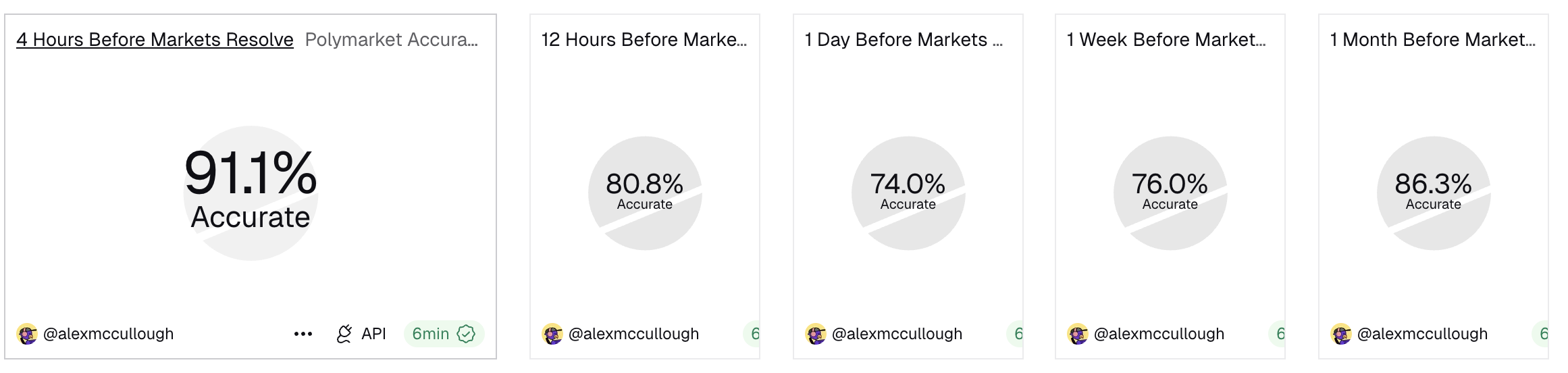
The numbers back this up, by the way. A study by data scientist Alex McCullough found that Polymarket predicts outcomes with a shocking 86% accuracy a month before the event resolves. And, wait for it, that jumps to 91% accuracy in the final four hours. So, uh, yeah. Take that, old-school polling.
The Polling Problem (Are Pollsters Just Guessing?)
Traditional polling has been struggling more than a toddler trying to put on shoes. After their embarrassing performance in 2016 and 2020, they still couldn’t figure out Kamala Harris’s chances in 2024. But prediction markets? They were already miles ahead, knowing exactly what was about to happen. It’s like they’re the seasoned gamblers, while polls are still on their training wheels.
George Tung insists this isn’t just luck; it’s skill. “If you’re predicting something big, like a presidential election or whether gold prices are going up-it’s skill,” he says. “It’s research, it’s study.”
Don’t Forget to Subscribe for More Insights
And let’s not forget speed. Polls take forever to process, while prediction markets adjust in minutes when new info rolls in. So yeah, accuracy is all about timing. And unfortunately for polls, they’re kind of slow.
Not Without Flaws (Because What Ever Is?)
Now, don’t get all starry-eyed about prediction markets just yet. Critics have some valid points. Like, if all the traders are from the same crowd, say, crypto bros who only buy 5% of a project to flex their portfolios, then guess what? One big spender could swing the market to reflect their personal bias. So, maybe not everyone in these markets is a genius economist.
But Tung isn’t having any of it. He fires back: “What other data source has more people predicting outcomes than prediction markets? Name one.”
“As the platform grows and more people join, the more accurate it’s going to be,” he adds. “But, seriously, what other form of data actually has more people predicting outcomes than prediction marketplaces?”
Touché, Tung. Touché.
His company, ClashPicks, is trying to solve this problem by making prediction markets more accessible-so everyone can take a shot, not just the crypto elite. It’s like they’re opening up the casino, but you don’t need to wear a suit and tie.
What Comes Next (In Prediction, Not the Apocalypse)
Will prediction markets completely replace polling? Honestly, who knows? But they’ve already made a dent. Big institutions like campaign strategists and media outlets are starting to rely on prediction markets as a supplement to traditional polling. It’s like, sorry polls, you’re now the second option.
And in case you thought this was all just a phase, let me drop this little nugget: In October 2025, the Intercontinental Exchange (ICE) plopped down $2 billion into Polymarket. Yeah, that’s $2 billion. So yeah, I guess prediction markets are a little more than a crypto fad.
The big question now is whether they can keep their ‘skin-in-the-game’ integrity while inviting more people into the market. More participants means more diverse opinions, but only if those people aren’t just guessing with their spare change. Balance, people, balance.
For now, prediction markets are the only real mirror we have for what people think will happen because getting it wrong means losing actual money. If that doesn’t keep things honest, I don’t know what will.
Read More
- Gold Rate Forecast
- Silver Rate Forecast
- Brent Oil Forecast
- Fear and Greed Index Hits 5-Month Low as BTC Drops to $109K – Warning or Buying Opportunity?
- XRP’s Wild Ride: To the Moon or Just a Bit Bouncy? 🚀
- Chainlink Soars, BNB Chain Joins the Party! What’s Next for LINK?
- US Data Center Gold Rush: How AI Is Reshaping Power Markets with a Side of Humor!
- Trump’s Big Moves: Crypto in 401(k)s and No More Banking Discrimination!
- 🚀 Solana’s November: Bull Run or Bull Plop? 🌽
- 🤑 Crypto Tragedy: Lambo, Bullets, and $19B Vanish! 😱
2026-02-27 13:35