As a researcher tracking cybercrime, I’ve found that those targeting cryptocurrency aren’t sticking to any predictable pattern. They don’t operate on a schedule; instead, they follow the flow of funds, striking when and where the money is moving.
According to Kraken’s head of security, Nick Percoco, increased hacking attempts in the cryptocurrency world usually happen when the market is doing well, during new product releases, or times of fast expansion. He explained this isn’t tied to specific dates, but rather because these are the times when the most valuable assets are gathered in one location, making them attractive targets.
Security flaws can be taken advantage of no matter what’s happening in the crypto market, according to Percoco. He stressed that protecting crypto isn’t a one-time fix, but something that needs constant attention.
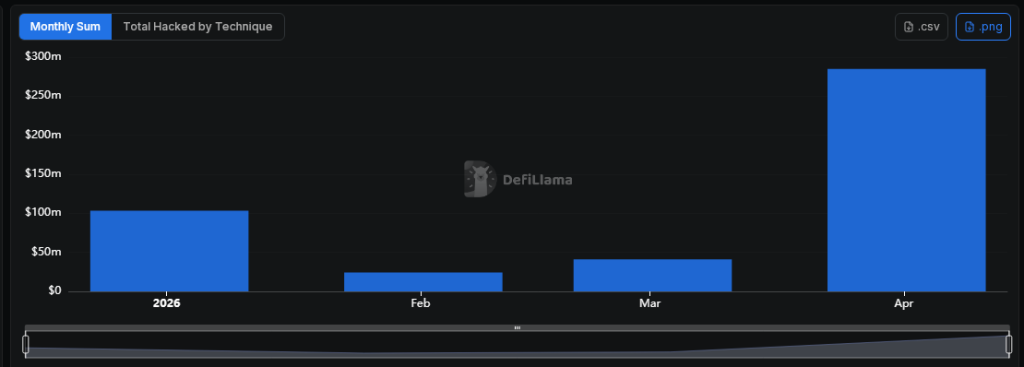
The statements were made following reports of a significant decrease in cryptocurrency theft during the first quarter of 2026. Data from DefiLlama shows hackers stole $168 million from 34 decentralized finance platforms between January and March, which is a substantial reduction from the $1.58 billion stolen in the same timeframe last year.
Private Keys And Smart Contracts Remain Weak Spots
The previous year’s number was significantly inflated by one major event: a $1.4 billion security breach at Bybit, which made up almost all of the losses in the first quarter of 2025. If you remove that single incident, the change appears less substantial.
However, the financial losses at the beginning of 2026 were significant. The most substantial loss occurred in January when Step Finance, a portfolio management platform, suffered a $40 million breach after hackers gained access to its private keys.

On January 8th, a security breach drained $26.4 million worth of ether from Truebit, a decentralized protocol, by exploiting a flaw in its smart contract. Then, in late March, Resolv Labs, a stablecoin issuer, suffered a similar attack – a compromised private key – using the same method as the Step Finance incident.
We’re seeing two ongoing security problems: issues with private keys and flaws in code. One stems from human error and how systems are used, while the other is a direct result of coding mistakes. Unfortunately, neither of these problems has been fully resolved.
North Korea-Linked Groups Remain A Persistent Concern
Over the last three months, 34 different DeFi platforms were attacked. These attacks happened consistently throughout the quarter, but January saw the biggest financial losses.
Percoco explained that the range of attackers includes well-organized teams, criminal groups, and individuals who are constantly looking for vulnerabilities in smart contracts and applications used by people.
Hackers believed to be connected to North Korea have been repeatedly linked to large-scale cryptocurrency thefts. Recently, they’ve been suspected of attacking Drift Protocol, a decentralized exchange, resulting in an estimated loss of $285 million due to a compromised private key.
Read More
- Brent Oil Forecast
- Gold Rate Forecast
- Silver Rate Forecast
- USD ISK PREDICTION
- EUR ILS PREDICTION
- Is Pi Network’s Price About to Take Another Dive? 🤔📉
- Dogecoin’s Delirious Dash: 200% Surge or Shaggy Shenanigans? 🐕🚀
- Unlock Huge Profits: STS Digital and Kraken’s Revolutionary Crypto Platform!
- XRP Flips BNB in Shock $93B Volume Spike: Sentiment vs Utility Battle
- Ant Group’s “ANTCOIN”: Will It Conquer Crypto? Find Out What’s Next!
2026-04-04 18:42