On June 12th, Bitcoin’s price increased as investors became more willing to take risks, likely due to hopeful signs of easing tensions between the U.S. and Iran.
Summary
- Bitcoin rebounded near $63,430 as Iran de-escalation helped reverse this week’s risk-off crypto pressure.
- Glassnode data showed options fear eased after one-week implied volatility briefly jumped toward 65%.
- Spot Bitcoin ETFs saw $19.03 million in outflows, extending redemptions for five straight sessions.
On June 12, Bitcoin was trading around $63,700, a slight increase of about 1% from the previous day, according to crypto.news data. Over the past week, the price has risen by 1.66%, bouncing back after recently dropping below $60,000.
Stock prices rose after investors responded positively to signs of decreasing tension between the U.S. and Iran. Reports indicated that President Trump called off planned military strikes against Iran and suggested a diplomatic agreement might be possible in the near future.
Following the recent announcement, oil prices decreased. Brent crude fell to around $85 a barrel, which helped to alleviate worries that rising energy costs would continue to drive up inflation.
This change is important for cryptocurrency because if inflation stays high due to oil prices, the Federal Reserve is likely to maintain its policy of raising interest rates. Conversely, if global tensions ease, it could reduce the pressure on investments like Bitcoin and other major cryptocurrencies.
Bitcoin and major crypto prices turn higher
Ethereum‘s price was around $1,671, a slight increase of about 0.97% in the last day. It remained near the $1,650 support level following a relatively slow week for Ethereum ETFs.
BNB was trading at around $605, and Solana was near $66.69 after increasing by almost 2% during the day. XRP also traded around $1.14, with a 3% daily increase.
Dogecoin was trading around $0.086, and Hyperliquid increased to approximately $59.17. While Hyperliquid performed well among the larger cryptocurrencies, it still showed a slight loss over the past week.
TRON performed the worst of the major cryptocurrencies listed. Its price was around $0.312, a decrease of 2.86% in the last 24 hours and 3.79% over the past week.
The recent recovery suggests traders are becoming less cautious. However, this is still a preliminary bounce and hasn’t fully recovered the losses from the June market decline.
Options data shows fear cooled
Glassnode reported that Bitcoin briefly fell below its February low before recovering to the level it reached in June. They also analyzed how options traders responded to this price fluctuation.
“Selloff Triggers a Temporary Volatility Spike,” said Glassnode.
Glassnode reports that Bitcoin’s expected price swings increased sharply when its price fell below the February low. This volatility briefly hit 65% before calming down.
Volatility in the options market returned to around 40%, indicating that traders didn’t expect the recent market recovery to be followed by another significant drop.
“Markets still view the selloff as a contained move,” said Glassnode.
Demand for protection against price drops increased sharply, then decreased. A measure called one-week skew rose from 12% to 28% as Bitcoin’s price fell, indicating a sudden need to protect against further losses.
The difference between implied and actual volatility briefly widened, then returned to around 12%. This change indicates traders initially purchased insurance against further price drops, and then scaled back that insurance as the price became more stable.
ETF outflows keep pressure on Bitcoin
According to data from SoSoValue, spot Bitcoin ETFs experienced net outflows of $19.03 million on June 11th. This continues a trend of five consecutive days of outflows, suggesting that institutional investors are currently being cautious with their investments.
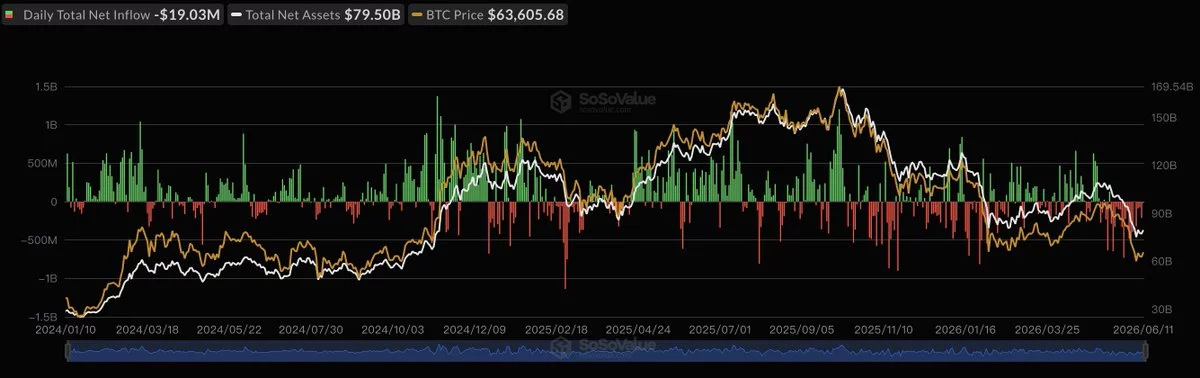
Ethereum ETFs experienced $15.89 million in net outflows that day, continuing a three-day trend of withdrawals from these funds.
As crypto.news reported earlier, the crypto market dropped sharply in June due to a combination of factors. These included rising interest rates from the Federal Reserve, increased tensions involving Iran, money leaving exchange-traded funds (ETFs), and the closing of leveraged positions.
As we’ve discussed before, the potential for a SpaceX IPO also diverted some investment money away from crypto. Our earlier report clarified that while the IPO boom wasn’t the sole cause of the market downturn, it did make crypto’s support weaker.
Bitcoin’s recent price increase is happening at the same time that exchange-traded funds (ETFs) are seeing some challenges. If more money starts flowing into these ETFs, it could strengthen Bitcoin’s recovery.
If withdrawals continue, the bounce may struggle to move beyond the next resistance areas.
Traders watch FOMC and $60K support
Despite recent gains, some experts caution that Bitcoin’s recovery could still be challenged. Crypto Rover points out that Bitcoin typically hits its lowest point every four years, and historically, this has happened around September or October.
“The 4-year cycle is running on schedule,” said Crypto Rover.
Bitcoin consistently follows a roughly four-year pattern. Looking at past cycles, the peak price has historically occurred between September and November of the third year – this happened in the last cycle with a high of $124,000. The lowest price of each cycle has consistently appeared between September and October. This pattern is currently unfolding as expected.
— Crypto Rover (@cryptorover) June 12, 2026
According to Kaz, Bitcoin hasn’t performed well following Federal Reserve meetings during the recent market downturn. He suggests that if the price doesn’t continue to rise, June 17th could be a date where it reaches a new, but lower, peak.
According to CryptoQuant’s Darkfost, both large investors (whales) and everyday traders sent more Bitcoin to Binance as the price dropped below $60,000. Over the past 90 days, whales averaged 5,280 BTC in inflows, and retail traders sent in around 410 BTC.
An increase in coins moving to exchanges can sometimes signal investor fear, as it suggests people may be preparing to sell. Darkfost noted this is similar to what happened in early February when Bitcoin also dropped below $60,000 and saw a surge in exchange inflows.
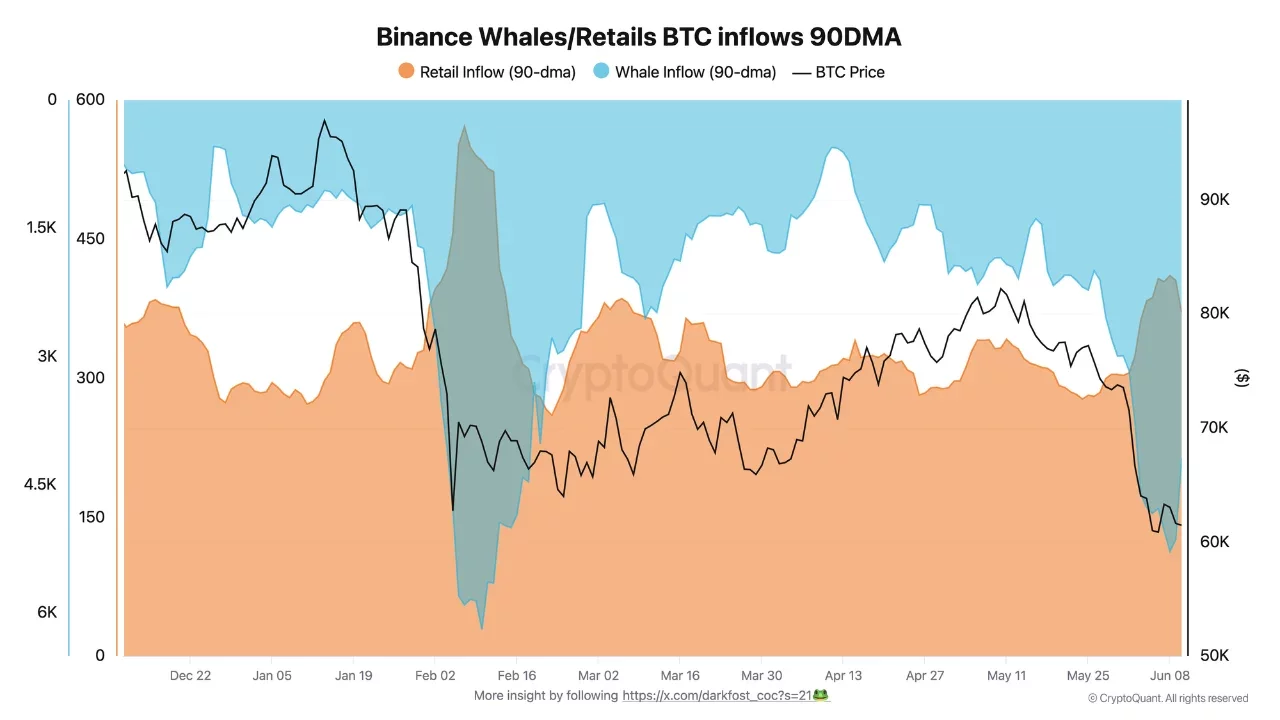
Currently, the $60,000 price point is a crucial level to watch. If the price stays above this level, it suggests the recent price drop might be over.
For Bitcoin to truly recover, it needs to rise above $65,000 and then continue climbing towards $68,000 or $70,000. Until that happens, the recent price increase is likely just a temporary gain within an unstable market.
Read More
- Crypto Exchange Bullish Shares Make a Splash: $102 Debut Beats IPO Price by a Mile!
- Bitcoin Spectacle: Strive buys 2,500 BTC as markets sigh
- Why Two Chinas Are Playing Games With Crypto Like It’s Monopoly 😱
- Crypto Drama: EDGE Token Plummets, ZachXBT Calls BS on Insider Shenanigans
- Bitcoin’s Gonna Crash? Maybe. Who Cares? Buy the Dip, You Coward!
- USD IDR PREDICTION
- CNY RUB PREDICTION
- Crypto RHONDA: Bursting Altcoins of July You Never Knew You Needed! 🔥😱💰
- Is Pi Network on the Verge of a Price Comeback or Just Another Cryptocurrency Comedy?
- USD JPY PREDICTION
2026-06-12 14:35