Vitalik Buterin, one of the creators of Ethereum, supports a new feature in the Kohaku wallet. This feature gives users a different blockchain address for each decentralized app (dapp) they use. Buterin believes this is a crucial first step towards improving privacy on the blockchain.
-
Key Takeaways:
- Vitalik Buterin has backed Kohaku’s per- dapp address feature, calling single global addresses a “norm we have to break” for Ethereum privacy.
- Kohaku’s v0.0.1-alpha.21 release made ERC-4337 relaying operational for Railgun transactions, reducing reliance on protocol-specific privacy infrastructure.
- Ethereum’s Kohaku, EIP-8250, and account abstraction upgrades are scheduled for the Hegotá hard fork in H2 2026.
Why Single Addresses Are a Privacy Problem
Most Ethereum users today interact with the network through a single persistent wallet address, a model that allows anyone to trace every token held, every protocol used, and every transaction made by a given user simply by querying public blockchain data.
Kohaku is an open-source project, supported by the Ethereum Foundation, that aims to make privacy features easier to add to cryptocurrency wallets. It provides wallet developers with building blocks to integrate confidential transactions and private data access directly into existing wallets, without forcing users to learn and use complicated, separate privacy systems.
The per- dapp address feature, highlighted by Buterin on May 27 and credited to contributors kassandraETH and ncsgy, takes a direct approach to the metadata leakage problem so that each time a user connects to a new application, the wallet automatically generates a fresh address.
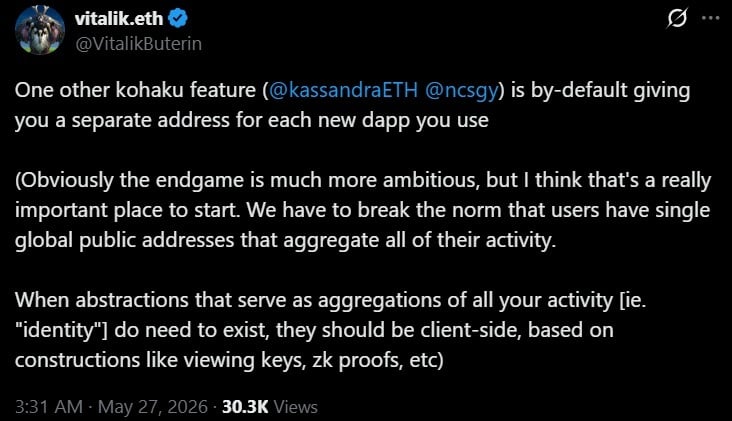
This breaks the onchain link between a user’s activity on a decentralized exchange ( DEX), a lending protocol, and any other dapp they interact with, making it substantially harder for data aggregators or surveillance infrastructure to build a complete financial profile of a given user.
Kohaku aims for a significant upgrade by working with existing Ethereum privacy features like Railgun and Privacy Pools. It simplifies the technical details, allowing everyday users to make private transactions directly from their usual wallets.
Part of a Broader Ethereum Privacy Push in 2026
The per- dapp address development is one piece of a wider Ethereum privacy roadmap Buterin outlined earlier in 2026. The near-term plan covers three specific initiatives, namely account abstraction combined with FOCIL (Fork-Choice enforced Inclusion Lists), Keyed Nonces (EIP-8250), and Kohaku. The majority of these upgrades are slated for Ethereum’s upcoming Hegotá hard fork, expected in the second half of 2026.
The latest update to Kohaku, version 0.0.1-alpha.21 of kohaku-eth/railgun, now allows Railgun privacy transactions to be sent using ERC-4337. ERC-4337 is a new standard for Ethereum that simplifies transactions. By using it, Railgun can reduce its dependence on special infrastructure, making privacy features more accessible to a wider range of users.
“We’ve accelerated narratives enough. Let’s accelerate the cypherpunk privacy reality.” Buterin wrote earlier this week, with the comment reflecting a broader shift in the Ethereum Foundation’s priorities wherein, after a decade focused primarily on scalability, the network is now pushing to restore the privacy guarantees that were central to its original design.
Read More
- USD JPY PREDICTION
- USD TRY PREDICTION
- USD CNY PREDICTION
- USD RUB PREDICTION
- USD AUD PREDICTION
- FIL PREDICTION. FIL cryptocurrency
- USD ZAR PREDICTION
- OKB PREDICTION. OKB cryptocurrency
- USD HKD PREDICTION
- SUI PREDICTION. SUI cryptocurrency
2026-05-27 14:57