In the dusty plains of the blockchain frontier, where code is law and wallets are smarter than the average bear, a specter is haunting Ethereum-the specter of relay dependence. Vitalik Buterin, the patron saint of smart contracts, has raised his voice, as gravelly as a farmer after a long day in the fields, to warn of a vulnerability lurking in the network’s transaction infrastructure. Smart contract wallets, those fancy crypto accounts controlled by programmable code, are shackled to third-party intermediaries just to get their transactions onchain. It’s like needing a middleman to deliver your mail in a town where everyone’s got a mailbox.
-
Key Takeaways:
- Vitalik Buterin flagged ‘relay dependence’ on X as a fragility concern for Ethereum’s smart wallet users. Like a rickety bridge over a deep ravine, it’s only a matter of time before someone gets left hanging.
- FOCIL and EIP-8141 are targeted for the Hegota upgrade in late 2026, aiming to rebuild the public mempool. Think of it as paving over that rickety bridge with a six-lane highway.
- EIP-7701 enables native account abstraction for Ethereum wallets, expected with the Hegota fork. Finally, wallets can be as smart as they think they are, without needing a babysitter.
The Problem With Relays
Smart contract wallets-those fancy crypto accounts controlled by programmable code instead of a standard private key-are sprouting up like weeds across the Ethereum landscape. They promise multi-signature security, social recovery, and gas sponsorship. But here’s the rub: they’re as dependent on third-party relay services as a farmer is on rain. Privacy protocols, too, are in the same boat, relying on these middlemen to get their transactions onchain. It’s like needing a bouncer to let you into your own party.
Buterin, ever the pragmatist, has called out this relay dependency as a weak link. If a relay goes offline or decides to play favorites, users are left high and dry, with no other way to get their transactions included. It’s the blockchain equivalent of a flat tire in the middle of nowhere, and no spare in sight.
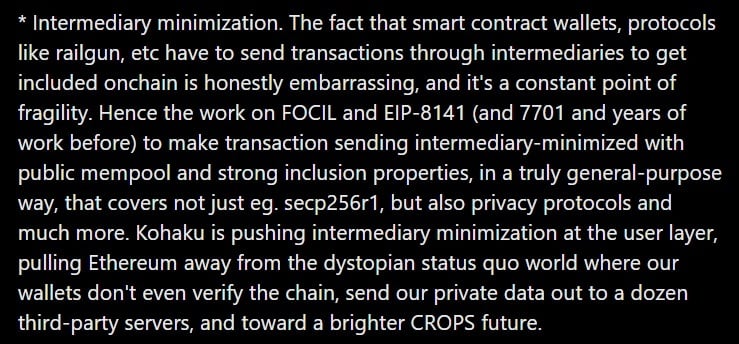
These centralized chokepoints are a slap in the face to Ethereum’s core principle of censorship resistance. It’s like preaching freedom while locking the gates. Buterin has made it clear: this is one of the two priorities for the Ethereum Foundation moving forward. The other? Probably making sure the coffee machine in the office works.
FOCIL and EIP-8141 Aim to Remove the Relay Bottleneck
Buterin’s solution? Two Ethereum Improvement Proposals (EIPs), the blockchain’s version of a town hall meeting, working alongside a new inclusion mechanism called FOCIL (Fork-choice Enforced Inclusion List). It’s like hiring a new postmaster to ensure everyone’s mail gets delivered, no questions asked.
FOCIL, scheduled for the Hegota upgrade in late 2026, introduces a mechanism that randomly selects validators to act as transaction “includers” for each block slot. It’s like a lottery, but instead of winning money, you get the privilege of processing transactions. This randomness makes it nearly impossible for any single actor to censor a transaction by refusing to relay it. The design aims for a one-to-two slot transaction inclusion guarantee, meaning valid transactions should find their way into the blockchain within two block intervals. It’s the blockchain equivalent of a well-oiled assembly line.
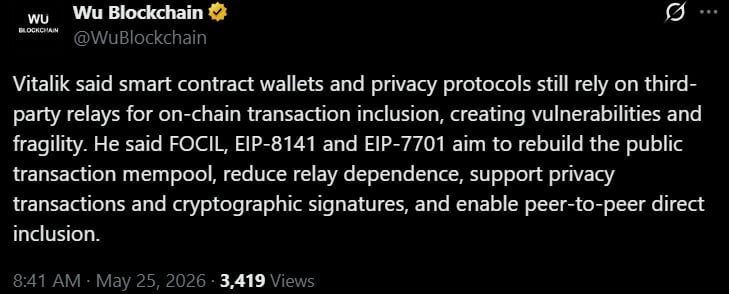
- EIP-7701 introduces native account abstraction, giving every Ethereum wallet the programmability currently reserved for smart contract accounts. It’s like giving every farmer a tractor, instead of making them plow by hand.
- EIP-8141 builds on EIP-7701, enabling features such as quantum-resistant signatures, key rotation, and gas sponsorship at the base protocol level. It’s the blockchain equivalent of adding a turbocharger to your tractor.
Under the combined FOCIL and EIP-8141 design, a smart contract wallet would submit transactions directly to the public memory pool (mempool), where a randomly selected FOCIL includer would pick them up. No wrappers. No intermediary broadcasters. No relay required at any stage. It’s like finally cutting out the middleman who’s been taking a cut of your crop for years.
Looking ahead, Buterin has stated that privacy and censorship resistance will be the Ethereum Foundation’s technical priorities. Bitcoin.com News reported on these strategic shifts last week. It’s like deciding to fix the barn roof before the next storm hits.
The Hegota upgrade is expected to be one of the most high-profile consensus-layer changes in Ethereum’s nearly decade-old history, especially since its transition to a proof-of- stake framework back in 2022. It’s like upgrading from a horse-drawn cart to a steam engine-a bit noisy, but a whole lot more efficient.
Read More
- CNY JPY PREDICTION
- USD CNY PREDICTION
- USD JPY PREDICTION
- USD TRY PREDICTION
- USD HKD PREDICTION
- NEAR PREDICTION. NEAR cryptocurrency
- EUR USD PREDICTION
- Ethereum to $24K? Jolly Good Show, What?
- SUI PREDICTION. SUI cryptocurrency
- Brent Oil Forecast
2026-05-25 10:57