President Trump has issued an order directing US financial regulators, and asking the Federal Reserve, to examine if companies involved in financial technology and cryptocurrencies should have greater access to the main systems used for payments. This move could be a significant step forward for companies like Ripple, which has been trying to obtain direct access to Federal Reserve services for its stablecoin plans, and brings this ongoing debate to the forefront of financial policy discussions in Washington.
A recent government order, issued on May 19th and focused on modernizing financial regulations, argues that outdated rules are hindering competition. The order states the government needs to update regulations to allow new technologies and digital assets to be used in traditional banking and payment systems. It also calls for the removal of unnecessarily complex and inconsistent regulations that make it difficult for new companies to compete with established financial firms.
For cryptocurrency companies, the key part of this new order concerns the Federal Reserve. It directs the Fed to review the rules around access to payment systems for companies like crypto firms that aren’t traditional banks. The Fed has 120 days to report back with recommendations, including whether current laws allow these companies greater access and if each regional Federal Reserve Bank can make its own decisions on applications.
What This Means For Ripple
The timing of these developments is significant for Ripple. In July 2025, CEO Brad Garlinghouse announced the company applied for a national bank charter in the US and requested access to the Federal Reserve’s payment system, including the ability to hold its RLUSD stablecoin reserves directly with the central bank. The Office of the Comptroller of the Currency confirmed Ripple’s bank charter application, and the request for a master account with the Fed was presented as a key part of Ripple’s overall plans for stablecoins and payments.
Ripple isn’t the only one making moves in the banking world. In March, Kraken Financial, the banking division of the cryptocurrency exchange Kraken, received a key approval from the Federal Reserve. This allows Kraken to directly access the US payment system – a first for a digital asset bank. Kraken had been working with regulators for over five years to achieve this, which eliminates the need for traditional intermediary banks when using Fedwire.
The approval given to Kraken is now being used as a model – and a cautionary example – for other companies in the industry. Kraken’s access is restricted; it was granted for one year and allows the firm to use Fedwire and hold limited overnight balances, but excludes benefits like interest on reserves, emergency loans from the Federal Reserve, access to FedNow, or ACH transfers. Ripple, Anchorage Digital, and Wise are among the other companies hoping to gain similar access.
This issue isn’t new – it’s already been debated in court. Custodia Bank, a similar crypto company based in Wyoming, applied for a master account with the Federal Reserve in 2020. When the Fed was slow to respond, Custodia sued in 2022, but their application was denied in January 2023. Later, in 2025 and 2026, appeals courts confirmed that the Federal Reserve Banks have the right to reject these applications. Now, Trump’s recent order specifically asks the Fed to consider this legal history.
Ripple is also considering a smaller-scale approach. In November, their chief legal officer, Stu Alderoty, stated that the Federal Reserve’s idea for limited accounts was appealing, even with restrictions. He explained that this option could still make it easier to redeem Ripple’s USD reserves without giving them all the advantages of a standard master account.
As an analyst, I’ve been tracking the Fed’s moves, and it’s important to note that they were already exploring ways to facilitate payments innovation *before* the Trump administration’s recent directives. Back in December, the Fed put out a request for public feedback on a potential new type of account – a specialized ‘payment account’ for eligible financial institutions. This wasn’t intended to be a full master account; it would be different in key ways – no interest earned, no access to Fed lending, and limits on how much money could be held in it.
Ripple’s plans to launch a stablecoin are highlighting the importance of ‘master accounts’ – access to the U.S. banking system. In December, Ripple announced that the Office of the Comptroller of the Currency (OCC) had given conditional approval to Ripple National Trust Bank, a federally regulated bank that would oversee the reserves for their stablecoin, RLUSD, under the supervision of both New York and federal regulators.
Ultimately, Trump’s order doesn’t give Ripple a special account. However, it does set a clear deadline for addressing a key question: should companies creating crypto payment systems and stablecoins have to rely on traditional banks, or should they be able to connect directly to the systems that handle dollar transactions, with appropriate safeguards in place?
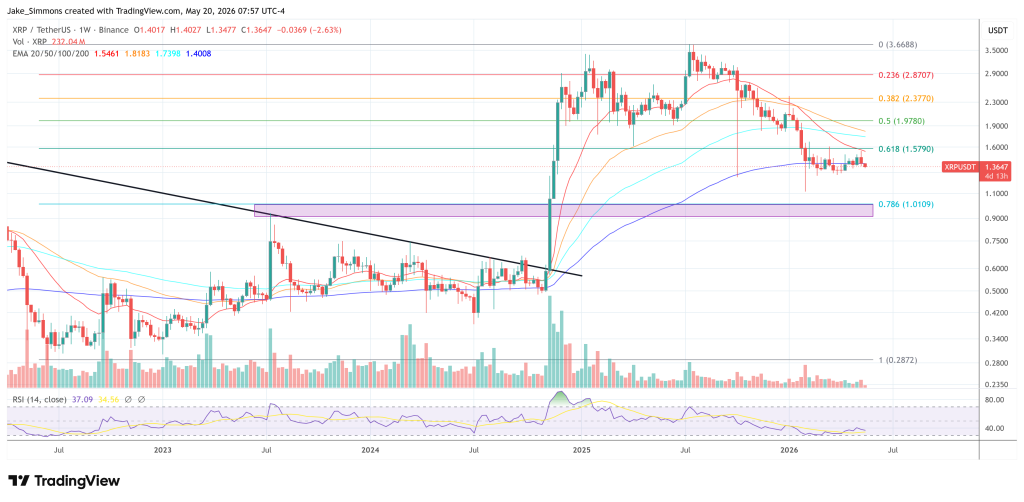
At press time, XRP traded at $1.3647.
Read More
- CNY JPY PREDICTION
- USD CNY PREDICTION
- USD JPY PREDICTION
- USD TRY PREDICTION
- USD HKD PREDICTION
- NEAR PREDICTION. NEAR cryptocurrency
- SUI PREDICTION. SUI cryptocurrency
- Brent Oil Forecast
- Ethereum to $24K? Jolly Good Show, What?
- EUR USD PREDICTION
2026-05-21 04:33