Southeast Asia is quickly becoming a leading global hub for cryptocurrency. A large, digitally-connected young population, increasing demand for sending money home, and clearer rules in several countries are all driving significant growth in crypto activity across the region.
Indonesia and Vietnam are becoming increasingly promising markets, and established centers like Singapore and Hong Kong continue to lead the way in combining institutional and retail financial services.
Diederik Van Wersch, Regional Sales Director for ASEAN and Hong Kong at Chainalysis, recently spoke with *The Crypto Times* about how quickly the cryptocurrency world is developing and changing.
Van Wersch shares insights based on his work with governments, banks, and police, covering how institutions are changing their views on crypto, important market predictions for 2026, growth patterns in different regions, the increasing popularity of stablecoins, and what the future holds for crypto technology in Asia and globally.
Question
From Containment to Participation: The Institutional Shift
The Crypto Times

You’ve spent several years at Chainalysis working closely with governments, financial institutions, and law enforcement. How has the institutional attitude toward crypto evolved during your time there — and what was the inflection point where you felt the conversation fundamentally shifted?
When I started at Chainalysis, the main approach to crypto from institutions was focused on managing its potential downsides. Governments were trying to assess the risks, law enforcement needed ways to track transactions, and most banks viewed digital currencies as something that could damage their reputation. Discussions almost always centered on potential problems.
Things have changed dramatically. Now, when I talk with banks, regulators, and governments throughout Southeast Asia and Hong Kong, the focus is on *how* to get involved with crypto – building safe and legal ways to enter the market, incorporating stablecoins into payment systems, and creating licensing and oversight frameworks instead of simply banning things. The discussion has shifted from *whether* to engage with crypto to *how* to do so in a way that’s both responsible and competitive.
The debate has shifted from simply asking if we should get involved with cryptocurrency, to figuring out how to participate in a way that’s both safe and effective.
Diederik Van Wersch, Chainalysis
Question
The Convergence Defining 2026
The Crypto Times

If we look at the current trends, is there any of Chainalysis’s on-chain data surfacing right now that you think deserves more attention than it’s getting?
I believe 2026 will be a turning point because of the combined impact of stablecoins, artificial intelligence, new regulations, and growing interest from traditional institutions. It’s not just one of these things happening, but all of them coming together and strengthening each other at the same time.
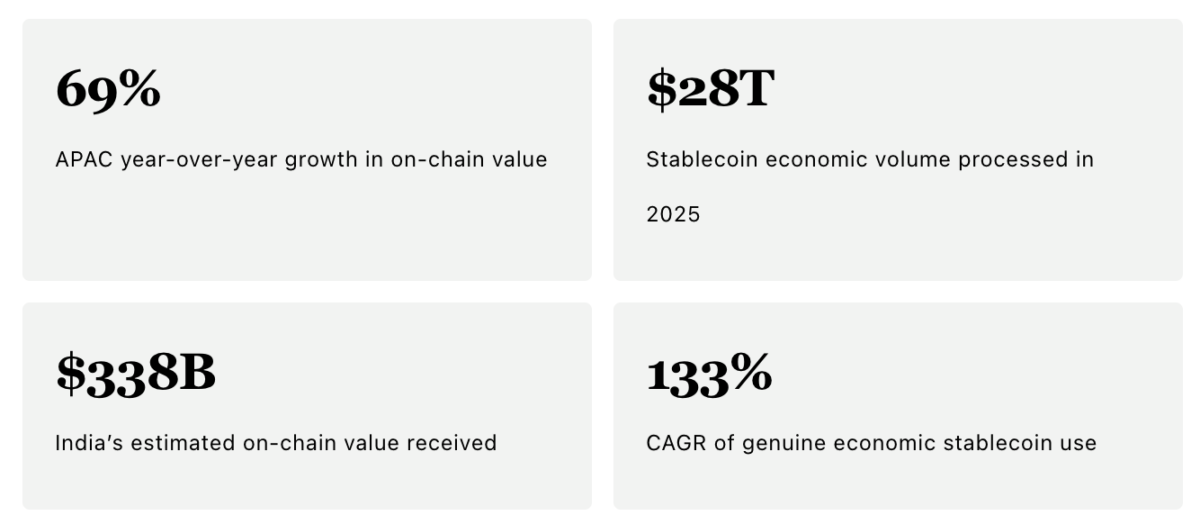
According to Chainalysis, stablecoins handled $28 trillion in transactions in 2025 and are growing rapidly. They could potentially match the transaction volume of Visa and Mastercard within the next ten years. This growth is encouraging banks and payment companies to adopt blockchain technology, creating a need for clear regulations.
Financial watchdogs in Asia, the Middle East, and the United States are taking action, particularly regarding stablecoins. Hong Kong, Singapore, and the United Arab Emirates are all creating or have already established rules specifically for these digital currencies. At the same time, artificial intelligence is being used by both criminals and those fighting financial crime. Fraudsters are reportedly using AI to commit more sophisticated fraud, while investigators and compliance teams are using it to improve detection, track money more quickly, and expand their capabilities.
As a crypto investor, I see 2026 as a huge turning point. It’s not about one big thing happening, but several key trends coming together at once – things like the growing use of stablecoins, big institutions finally getting involved, clearer rules from regulators, and the rise of AI. It’s this combination of factors that makes 2026 feel so important – there isn’t just one single buzzword to describe it, and that’s exactly why it’s such a pivotal year for crypto.
Question
Where the Geographic Center of Gravity Is Moving
The Crypto Times

Drawing from Chainalysis’s Global Crypto Adoption Index and your regional work, how is the geographic center of gravity in crypto shifting heading into 2026? Which regions are accelerating, and which are losing ground? Also, beyond the well-known hubs, which underrated jurisdictions are you watching closely as the next wave of crypto activity?
The Asia-Pacific region (APAC) saw the biggest jump in cryptocurrency activity, with the value of crypto received increasing by 69% compared to the previous year. Several countries within APAC are leading this growth.
India leads the world in crypto adoption, topping our Global Crypto Adoption Index in all categories – individual investors, centralized exchanges, decentralized finance, and institutional investment. The country has received an estimated $338 billion in crypto value, fueled by widespread public interest, money sent home by Indians living abroad, and a growing financial technology sector that easily incorporates cryptocurrency. How India chooses to regulate crypto will significantly impact the global crypto market.
Japan experienced the most significant growth among the top five markets in the Asia-Pacific region, with a 120% increase over the last year. This surge is thanks to changes in regulations, anticipated updates to crypto tax laws, and the approval of the country’s first company to issue a stablecoin backed by the Japanese yen. After a period of slow activity, Japan is now demonstrating strong and revitalized growth in the crypto space.
Indonesia’s cryptocurrency market is booming, growing by 103% in the last year and becoming one of the fastest-growing in Southeast Asia. With a large, young population that readily uses mobile devices and increasing clarity in regulations, Indonesia is a market with significant potential.
I’m also keeping a close eye on Vietnam. While its crypto growth was ‘only’ 55%, that’s because cryptocurrency is already a common part of daily financial life there – people use it for sending money home, gaming, and saving. It’s a place where crypto is actually being used in practical ways.
Question
Hong Kong vs Singapore vs Dubai: Different Hubs, Different Wins
The Crypto Times

Hong Kong vs Singapore vs Dubai: Hong Kong has aggressively positioned itself as Asia's crypto hub. How would you assess its progress against Singapore and Dubai — and importantly, are these hubs competing for the same thing, or are they winning in different segments (such as institutional capital, retail, builders, infrastructure)?
These markets are all competing in somewhat different ways, and those differences are becoming more pronounced as they shift from creating the basic structure to putting those structures into practice.
Singapore is leading the way in regulating digital payments. The Monetary Authority of Singapore (MAS) has expanded its rules – originally focused on anti-money laundering and counter-terrorism financing – to now include consumer protection, technology risks, and specific guidelines for stablecoins. MAS is even exploring allowing banks to hold regulated stablecoins on public blockchains with reduced capital requirements, and is testing programs involving digital government bonds and wholesale central bank digital currency settlements. This demonstrates Singapore’s willingness to quickly adopt and build out real-world payment and settlement systems.
Hong Kong has rapidly transitioned from testing virtual assets to establishing formal regulations. With the new Stablecoins Ordinance in effect, the Hong Kong Monetary Authority (HKMA) issued its first licenses for stablecoins in April to HSBC and a group led by Standard Chartered. The fact that these licenses went to major, well-established banks—rather than companies focused solely on cryptocurrency—highlights Hong Kong’s strategy: prioritizing institutions, strict oversight, and building trust. HSBC intends to integrate its stablecoin directly into its PayMe platform, potentially reaching over three million users and marking a significant development in the world of on-chain payments.
The UAE is making progress in regulating stablecoins as a way to improve payments. The country’s central bank has rules for tokens backed by the dirham, and different financial authorities – VARA, ADGM, and DIFC – each have their own specific regulations. This approach could be quick and adaptable, but it also risks creating confusion. A crucial moment will be September, when the central bank’s new rules for payment tokens take effect and we’ll see how well the system works.
As an analyst, I’ve been closely watching the approaches of Singapore, Hong Kong, and the UAE. Singapore really focuses on strong regulations and how well its financial institutions work together. Hong Kong leverages the trust in its banks and its broad access to individual investors. The UAE, on the other hand, stands out with its quick implementation and willingness to adapt to commercial needs. However, what will truly set these markets apart from each other is how effectively they address financial integrity – things like preventing money laundering and financial crime.
As a researcher following the regulatory landscape of digital assets, I’ve been observing Hong Kong’s approach to stablecoins closely. What’s particularly interesting is their requirement for issuers to monitor activity on the broader market, not just who they directly transact with. They’re really taking advantage of the transparency offered by public blockchains – something traditional anti-money laundering systems struggle to do. I believe that as stablecoins become more widely used for everyday payments, the countries that proactively address these risks will be the ones to attract and retain significant investment from institutional players.
Question
How Stablecoins Are Reshaping Cross-Border Flows
The Crypto Times

Stablecoins have quietly become one of crypto's biggest stories—settlement volumes now rival major payment networks. From Chainalysis's vantage point, how is stablecoin adoption reshaping cross-border flows, especially in emerging markets like India and Southeast Asia?
Stablecoins are now a significant part of how payments are made, and the numbers prove it. In 2025, they handled $28 trillion in economic activity. Even when removing trading and speculation, focusing only on real-world uses like payments and money transfers, stablecoin usage is growing at an impressive rate of 133% per year.
Recent actions by leading financial companies demonstrate a clear change in focus. Stripe buying Bridge and Mastercard teaming up with BVNK aren’t about increasing trading activity—they’re investments in the underlying technology that handles payments.
Across Southeast Asia, the Middle East, and Latin America, businesses and individuals are increasingly using stablecoins to send money across borders. This method is significantly faster and cheaper than traditional banking systems.
While still in its initial stages, the shift towards wider stablecoin use requires comprehensive regulation. This shouldn’t just cover how stablecoins are created, but also how they’re distributed, used in transactions, and connected to current payment systems. We’re currently working on these issues, which is why we’re dedicated to providing institutions with the tools they need to manage risk and stay compliant during this evolving process.
Question
The Most Under-Reported Number in Crypto
The Crypto Times

Is there a surprising data point or pattern from Chainalysis's research that your team finds genuinely fascinating but rarely makes it into mainstream coverage? Something that would make our audience see the space differently?
It’s important to remember that illegal activity makes up a surprisingly small portion of all cryptocurrency transactions. Data from Chainalysis consistently demonstrates that illicit transactions are a minor part of the overall market, and this has stayed true even as cryptocurrency use has become more popular.
Most activity on blockchains is perfectly normal – things like everyday payments, saving money, sending remittances, and businesses settling transactions, as well as people using decentralized finance. This is important because many people still think of crypto as mainly being used for illegal activities. However, blockchains are actually *more* transparent than traditional systems, making illegal activity easier to track. That’s why law enforcement agencies globally are increasingly using blockchain analysis tools.
We’ve been able to track down and reclaim billions of dollars in illegally obtained funds thanks to the transparency of public blockchains – something traditional financial systems don’t offer.
While the openness of cryptocurrency can worry some, it’s actually its biggest advantage when it comes to keeping finances honest and secure.
Diederik Van Wersch, Chainalysis
Read More
- Gold Rate Forecast
- USD RUB PREDICTION
- GBP USD PREDICTION
- ETH PREDICTION. ETH cryptocurrency
- FIL PREDICTION. FIL cryptocurrency
- USD ILS PREDICTION
- PI PREDICTION. PI cryptocurrency
- Bitcoin to $90K? Retail Investors Say “Yes,” Tina Fey Says “Hold My Latte”
- EUR USD PREDICTION
- Bridge of the Damned: Syndicate’s $400K Crypto Heist Makes ‘DeFi’ Sound Like ‘Oh No!’
2026-05-14 16:25