This week is a critical moment for the cryptocurrency industry. The US Senate Banking Committee will vote on the CLARITY Act this Thursday, May 14th. This vote will decide whether the most extensive crypto legislation to date moves forward for a full Senate vote, or if lawmakers need to go back to the drawing board. The discussions and actions leading up to the vote are just as important as the vote itself.
Eleanor Terret, host of Crypto America, reports that banks are heavily lobbying Washington regarding stablecoin legislation. Since last Friday, members of the American Bankers Association have sent over 8,000 letters to senators, asking them to revise a specific part of the proposed bill. This effort is entirely focused on letter writing – the banking industry isn’t making phone calls, indicating they believe a high volume of letters alone will be effective.
The main goal of this push is clear: the CLARITY Act aims to stop companies from offering high interest rates on stablecoins – like the popular practice of earning 3% to 5% simply by holding USDC. This would limit what stablecoin issuers, exchanges, and wallet providers can offer. Banks stand to gain from these restrictions and are actively working to make sure the final version of the Act includes them.
Thursday’s vote will reveal whether 8,000 letters were enough.
The Amendments That Will Define Thursday’s Vote — and the Industry’s Next Decade
Recent behind-the-scenes negotiations have highlighted key areas of disagreement. According to political and financial journalist Brendan Pedersen, Senators Reed and Smith have proposed an amendment that will essentially force a decision: either support the cryptocurrency industry or the traditional banking sector. This amendment includes changes favored by banks regarding restrictions on stablecoin yields, and seems to be a direct result of the 8,000 letters submitted by members of the American Bankers Association.
As an analyst, I’ve been following the latest developments regarding potential amendments to existing legislation, and Eleanor Terret has highlighted some significant changes. Specifically, a proposed Reed amendment would effectively prevent the use of cryptocurrency as legal tender, meaning you couldn’t use it to pay your taxes. This is a direct response to a bill proposed last year by Representative Davidson, which aimed to allow Bitcoin – and potentially other cryptocurrencies – to be used for those very payments. It’s a clear push and pull between opposing viewpoints on crypto’s role in the financial system.
Senator Warren is leading the charge with over 40 proposed changes before Thursday’s debate. The most impactful would block the Federal Reserve from allowing crypto companies to open master accounts. This would essentially cut off a key way for these firms to connect directly to the US banking system.
Thursday’s meeting isn’t just a vote on the CLARITY Act. It’s now a negotiation to decide how much of a role cryptocurrency will have in the U.S. financial system. Any decisions made – through proposed changes – will likely be very hard to reverse later.
Crypto Market Reclaims $2.6 Trillion As Recovery Structure Strengthens
The total value of all cryptocurrencies is currently around $2.68 trillion. This is a significant bounce back from a dip in February, which briefly brought the market down to around $2.2 trillion. Over the past few weeks, the crypto market has become more stable, and buyers have regained control of key price points, suggesting a solid recovery is underway.
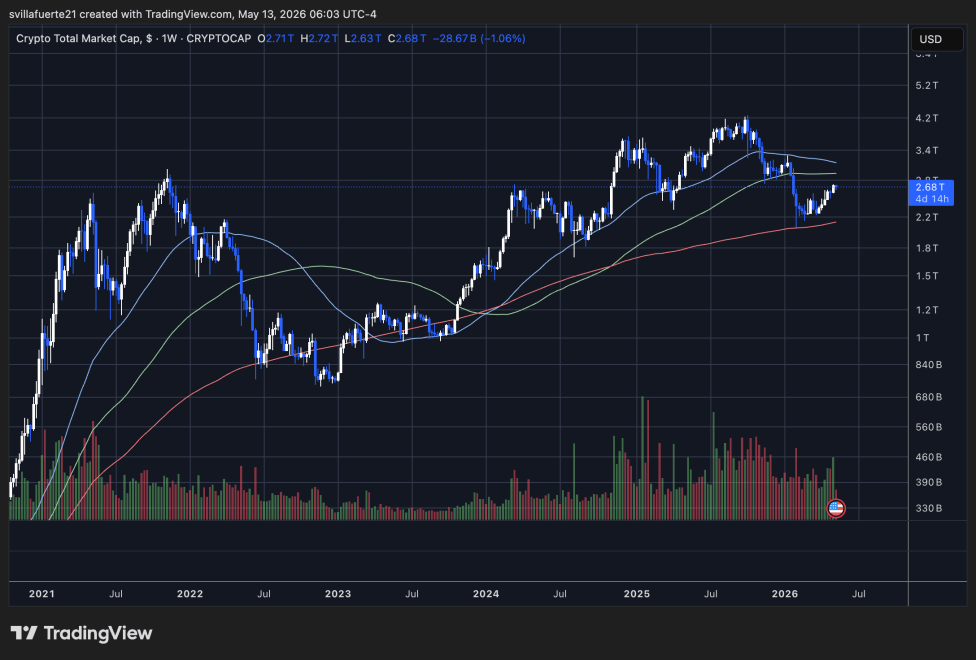
A key development is the market regaining its position above the 200-week moving average, which is currently around $2.55 trillion. In the past, this level has reliably signaled shifts in long-term trends, distinguishing periods of growth from significant downturns. Staying above this point indicates the market may be moving out of a period of selling pressure and starting to rebuild.
The market is still trading below key levels – the 50-week moving average around $3 trillion and the 100-week moving average near $3.2 trillion. These levels represent significant barriers for buyers, and need to be broken through before we can confidently say the market is entering a sustained uptrend.
Trading volume is much lower now compared to the high levels seen during the market drop in February. This suggests that urgent selling is easing, but it also means we haven’t yet seen a full return of strong new investment.
Read More
- Gold Rate Forecast
- GBP USD PREDICTION
- USD RUB PREDICTION
- ETH PREDICTION. ETH cryptocurrency
- FIL PREDICTION. FIL cryptocurrency
- USD TRY PREDICTION
- USD ILS PREDICTION
- PI PREDICTION. PI cryptocurrency
- Bitcoin to $90K? Retail Investors Say “Yes,” Tina Fey Says “Hold My Latte”
- SKYAI/USD
2026-05-14 04:57