Ripple, Ondo Finance, Mastercard, and J.P. Morgan have successfully completed a test transaction that linked the XRP Ledger blockchain with traditional banking systems. This test demonstrated how digital versions of real-world assets – in this case, tokenized US Treasury bonds from Ondo Finance (OUSG) – can be exchanged using blockchain technology and then settled with actual money through Mastercard and J.P. Morgan’s networks.
Ondo announced that this test transaction marks the first time a tokenized US Treasury fund has been redeemed across borders and between different banks in near real-time. The goal was to demonstrate how redeeming these tokenized funds can go beyond simple digital transfers and connect directly with existing banking systems used for international payments.
Ondo reports that Ripple cashed in some of its US Treasury holdings that were stored on the XRP Ledger. Ondo handled the process, and Mastercard’s network sent the payment request to Kinexys (a J.P. Morgan service). Kinexys then took the funds from Ondo’s account and sent US dollars to Ripple’s bank account in Singapore using J.P. Morgan’s banking system.
Ripple, JPMorgan And Mastercard Test XRP Ledger
The way these systems are built is important because even though real-world assets are turned into digital tokens, redeeming them for actual money often still relies on traditional banking methods. While tokens can move instantly on a blockchain, getting the money back into a bank account can be slow, involving wire transfers, manual processing, and limited banking hours. This test program explored a better approach: combining a public blockchain with existing bank infrastructure so the entire process happens as one smooth transaction.
Ondo sees this deal as a major step forward for the future of finance. In a post on X, the company explained that it’s the first time tokenized US Treasury bonds have been transferred across international borders and between banks almost instantly, outside of normal business hours. This marks the first instance of a public blockchain and traditional banking systems working together to complete a real-time, cross-border transaction involving a tokenized fund. Ondo believes this is a crucial step towards creating financial markets that operate 24/7.
Ripple described the test as an important move towards making global financial markets operate around the clock. They explained that connecting XRPL with existing banking systems demonstrates how institutions can handle international transactions seamlessly in one process.
The transaction’s digital asset component took place on the XRPL network, completing in under five seconds, as announced in the press release. Vet, a validator for the XRP Ledger and active community member, spotted two recent Ripple transactions that seemed to be related to the OUSG redemption process, which is linked to the Mastercard and J.P. Morgan payment system. According to Vet, these transactions completed in just a few seconds and cost only fractions of a penny.
This pilot program demonstrates another way institutions can use the XRPL for settlements, just as public blockchains are gaining traction for handling tokenized versions of things like funds, government bonds, and other real-world assets. According to Markus Infanger, a senior vice president at RippleX, the transaction highlights how tokenized assets can move seamlessly between public blockchains and traditional financial systems.
This is a significant achievement, proving that digital assets can easily transfer between blockchains and the traditional financial world, according to Infanger. The XRP Ledger allows for instant asset transfers, and this test program highlights how banks can process international payments as one smooth process when combined with existing banking systems.
Mastercard and Kinexys, a J.P. Morgan company, played key roles in this institutional transaction. Mastercard’s network handled the instructions for settling the payment, and Kinexys used J.P. Morgan’s blockchain technology to complete the payment in traditional currency. It also facilitated further instructions through J.P. Morgan’s existing banking network. This wasn’t simply a blockchain transfer; it demonstrated how digital assets and traditional banking systems can work together seamlessly.
Zack Chestnut, who leads commercialization at Kinexys by J.P. Morgan, explained that the recent pilot program wasn’t just a test, but a step towards building a comprehensive system for tokenized assets. He believes that for tokenized financial products to become widely used, banks, companies across different industries, and blockchain technology need to work together globally. He expressed enthusiasm about continuing to collaborate with Ondo, Ripple, and Mastercard to make this vision a reality.
Mastercard is focusing on making tokenized transactions work smoothly and on a large scale. Raj Dhamodharan, a company executive, explained that increasing interest from institutions is driving the need for faster payment systems. He stated that as more institutions adopt tokenized assets, the emphasis is moving towards enabling quick and efficient transactions. Mastercard’s new Multi-Token Network aims to facilitate near-instant, international payments using existing bank accounts, fostering better coordination, trust, and compatibility within the digital asset space.
Ondo explains that its system allows users to redeem OUSG tokens from any public blockchain where they are available, such as XRPL. However, OUSG remains a limited product, only accessible to investors who meet specific accreditation and qualification requirements, as stated in the company’s legal documents.
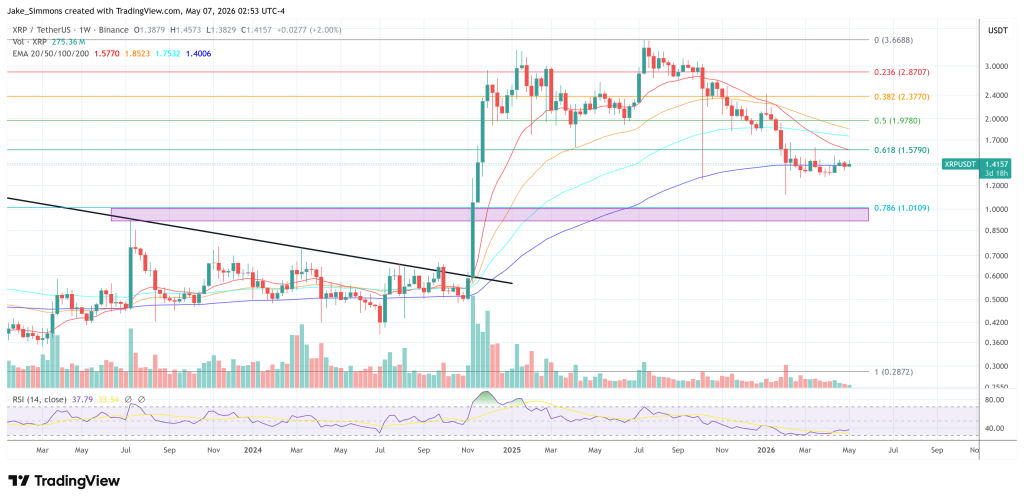
At press time, XRP traded at $1.4157.
Read More
- CNY JPY PREDICTION
- USD TRY PREDICTION
- USD CNY PREDICTION
- USD JPY PREDICTION
- USD HKD PREDICTION
- Ethereum to $24K? Jolly Good Show, What?
- NEAR PREDICTION. NEAR cryptocurrency
- FIL PREDICTION. FIL cryptocurrency
- SUI PREDICTION. SUI cryptocurrency
- Hong Kong’s Strict Stablecoin Rules: Only 2 Licenses Out of 36 Applications Approved!
2026-05-07 14:16