Recent movement of XRP from centralized exchanges shows a significant shift, with large XRP holders (often called ‘whales’) now driving the outflows. This pattern is remarkably similar to what happened before the token’s price dropped by over 61% from its high point in July 2025 – but in reverse. Previously, smaller, individual investors were the primary drivers of exchange outflows.
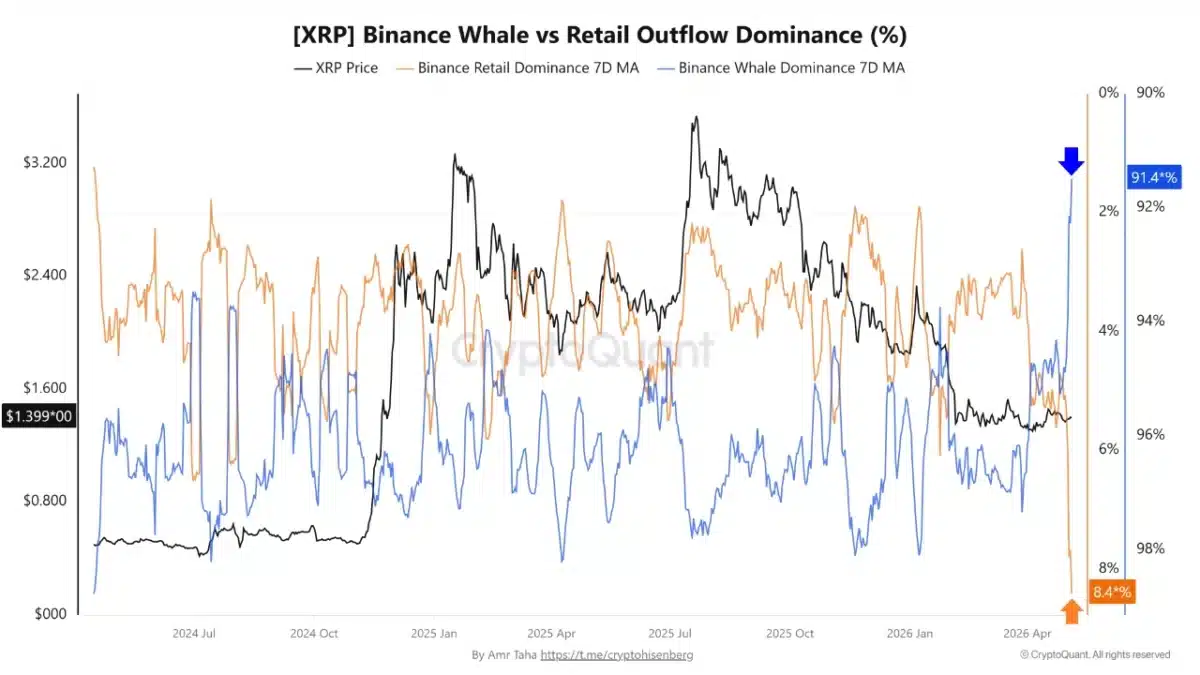
Binance is seeing a significant shift in XRP outflows, according to analyst Amr Taha from CryptoQuant. Now, 91.4% of XRP leaving the exchange is from large transfers made by whales, while only 8.4% comes from smaller transactions by individual retail investors. This indicates that whales are now overwhelmingly responsible for the movement of XRP off of Binance.
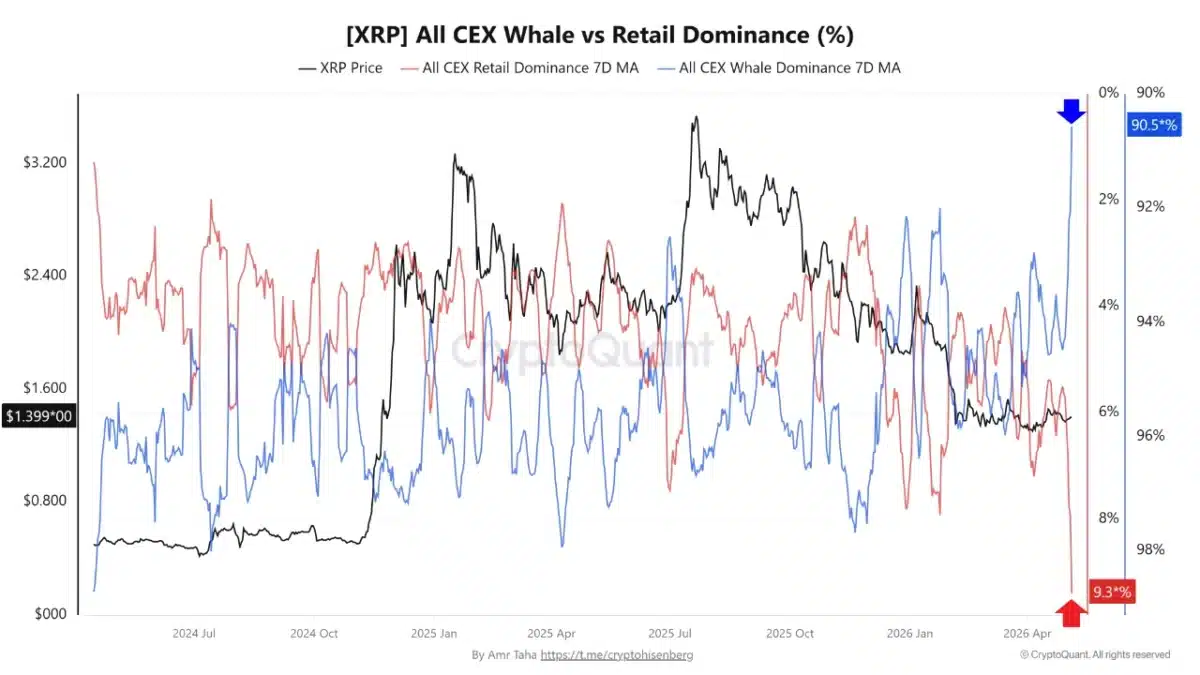
We’re seeing a similar trend across all major cryptocurrency exchanges. Large investors (often called ‘whales’) now control 90.5% of the market – the highest percentage since the beginning of the year. Meanwhile, the share held by smaller, individual investors has dropped to just 9.3%, a new low for the year. This shows that the recent large-scale selling isn’t just happening on Binance, but across the entire exchange landscape.
XRP is currently trading around $1.40. It’s been moving within a narrow price range recently, and is nearing a breakout point. Traders are watching closely to see if it can break above $1.45, which would likely signal a significant price increase, potentially reaching $2.15.
The Mechanics of the Signal
The Outflow Dominance metric shows how much XRP leaving exchanges is moved by different-sized wallets. Currently, large XRP holders (those moving over 1 million XRP at a time) are responsible for 91.4% of the total value of XRP leaving Binance. This means that for every 100 XRP units leaving Binance, about 91 are moved by these large holders.
Taha observed that when the metric shows whales controlling over 85-90% of the activity, it usually means large transfers are happening. This happened in October 2024 and June 2025, and both times XRP’s price went up soon after.
However, the analyst cautioned against jumping to conclusions. Coins leaving an exchange can happen for many reasons, like moving them to secure offline storage, changing who holds them, internal exchange processes, settling trades directly with others, or simply repositioning assets. Just because large players are moving coins doesn’t necessarily mean they’re buying more. What it *does* show for sure is that these outflows aren’t driven by typical individual traders – and that difference in who’s moving the coins is the important takeaway.
The Mirror Image of July 2025
The most important part of Taha’s analysis is his direct comparison to July 2025. Back then, the market situation was flipped, and XRP was nearing its highest point in the cycle.
Back then, retail investors were very active, accounting for almost 2% of all trading, and XRP was trading near its highest price for the cycle, around $3.50. This high level of activity from smaller investors was followed by a significant price drop of over 61%, showing how vulnerable the market was when many of them were buying near the peak.
The current situation with XRP is a stark contrast to its past. Back in July 2025, when XRP was trading around $3.50 and mostly held by smaller investors (around 2%), it faced certain weaknesses. Now, in May 2026, with XRP at $1.40, a very large percentage of the tokens are held by a few major players – about 91% on Binance and 90.5% across all centralized exchanges. Looking solely at the movement of tokens leaving exchanges, this new setup is the complete opposite of what we saw before.
This doesn’t guarantee XRP will start rising again, but it’s the clearest sign we’ve seen since July 2025 that the on-chain data is mirroring the conditions before the previous price drop. Analysts who study on-chain data believe this pattern, combined with other signs of increasing investment, could predict a future price increase.
The Broader Whale Activity Context
As a crypto investor, I’ve been watching XRP closely, and the latest data is interesting. It looks like we’re seeing a continuation of a trend in activity from the big XRP holders – the ‘whales’. According to Santiment, the number of XRP addresses holding over a million XRP has actually *increased* by 42 since the beginning of 2026. That’s the first time we’ve seen that happen since September 2025, so it’s a potentially positive sign.
Goldman Sachs is now the biggest institutional investor in XRP ETFs, holding a total of $153.8 million worth of XRP across four different ETF products.
XRP ETFs saw positive investment activity in April 2026, with $81.59 million flowing in over the past 13 trading days (according to SoSoValue). This is a turnaround from the $31.16 million outflow experienced in March, and puts these ETFs on pace for their best month of inflows since December 2025.
The fact that whales currently control 91.4% / 90.5% of the market isn’t a one-time event. It’s happening alongside several other trends that started in March: more money flowing into ETFs, an increase in wallets held by millionaires, decreasing balances on cryptocurrency exchanges, and indicators showing whales are consistently accumulating. These factors all point to the same thing.
What’s Different This Time
Three things distinguish the current setup from prior whale-dominance readings:
Previously, signals of large whale outflows (large amounts of cryptocurrency being withdrawn) were usually limited to the Binance exchange. Now, we’re seeing this pattern across almost all centralized exchanges (CEXs), with 90.5% of the outflow happening across the entire CEX landscape. This widespread activity makes it less likely that the signal is just due to something happening on a single exchange.
Retail investors are selling off significantly less cryptocurrency. Currently, only 8.4% of outflows on Binance and 9.3% across all centralized exchanges (CEXs) come from individual investors – the lowest level seen this year. This isn’t a short-term trend; it signals a fundamental shift in who is driving the market, with larger investors now dominating.
The timing of whale activity is important. If large investors start selling around the predicted peak of $3.50 in July 2025, it likely signals they are distributing their holdings. However, current selling at $1.40 – after a significant 61% drop from its highest point – suggests these large investors are actually buying the dip. These two scenarios represent very different market conditions.
What the Analyst Did NOT Say
Taha clarified that while the recent movement of XRP doesn’t necessarily mean people are buying and holding it, the pattern suggests that large investors, not everyday traders, are driving the current outflows.
Looking at the blockchain data, we’re seeing a potentially positive pattern that’s the opposite of what we saw before the price drop in July 2025. Whether this leads to a price increase depends on if large investors are buying (accumulating) or selling (redistributing) their holdings – something we’ll only know for sure later on.
Read More
- CNY JPY PREDICTION
- Ethereum to $24K? Jolly Good Show, What?
- SUI PREDICTION. SUI cryptocurrency
- USD JPY PREDICTION
- USD HKD PREDICTION
- GBP USD PREDICTION
- USD IDR PREDICTION
- USD TRY PREDICTION
- Gold Rate Forecast
- Hong Kong’s Strict Stablecoin Rules: Only 2 Licenses Out of 36 Applications Approved!
2026-05-05 15:05