April 2026 unfolded with the astonishing grace of a caffeinated seagull, as DeFi stumbled through 18 days of misadventure and misfortune. In a month that felt engineered by a prankster with a ledger, over $606 million vanished into hacks and exploits across a dozen incidents. Two calamities-$285 million siphoned from Drift Protocol on April 1 and roughly $292-293 million drained from Kelp DAO’s rsETH on April 18-19-carved out about 95% of the month’s losses, like a top-heavy pie chart that forgot to balance itself.
What began as a rather tidy social-engineering operation snowballed into a systemic soap opera: unbacked liquid restaking tokens (LRTs) roared into lending markets, utilization surged to the moon and back, and bad debt drifted somewhere between $124 million and $230 million. Withdrawals spiked to $6-13 billion in DeFi total value locked, and emergency freezes fluttered across protocols as if a digital frost had settled on the whole darn system. By April 23, even the world’s most famous stablecoin wasn’t safe-Tether froze $344 million in USDT on Tron at the behest of U.S. law enforcement.
April 2026 surpassed every previous month for DeFi losses since February 2025’s Bybit breach, with 2026’s year-to-date hacks creeping toward $772 million. This wasn’t a streak of accidental misfortune but a textbook cascade that highlighted the fragile web of cross-chain bridges, LRT composability, governance that’s mostly human, and the disconcerting truth that “decentralized” systems often lean on centralized emergency powers when the stakes are existential.
The Opening Salvo: Drift Protocol and Lazarus Group’s Long Game (April 1)
The month began with what many dismissed as an elaborate April Fools’ prank. Drift Protocol, a Solana perpetual futures exchange, lost about $285 million in roughly 12 minutes. Hackers drained vaults holding USDC, WETH, JLP tokens, and other assets through compromised admin privileges and pre-signed durable nonce transactions. No core smart-contract bug can lay claim here; this was a social-engineering coup stitch by stitch, traced to North Korea’s Lazarus Group (aka UNC4736 or TraderTraitor).
Inside scoops suggest Lazarus operatives infiltrated Drift’s contributors via fake identities, conference meetups, and malware aimed at cloud infrastructure and personal devices. Once inside, they exploited governance quirks to drain the coffers. Drift paused deposits and withdrawals, while on-chain sleuths like PeckShield and Elliptic promptly flagged the North Korean connection-patterns familiar from state-sponsored operations, including referencing Tornado Cash for laundering.
The hack set a grim tone, but it was only the curtain-raiser for a longer, louder drama. It exposed a stubborn DeFi vulnerability: even audited protocols with robust on-chain security remain exposed to off-chain human foibles and operational risks.
Mid-Month Bridge Warning Shot: Hyperbridge’s Forged Message and 1 Billion Fake DOT (April 13)
Just twelve days after Drift, a bridge vulnerability appeared that, while smaller in realized losses, sent tremors through the interoperability cosmos. On April 13 at about 03:55 UTC, an attacker exploited a flaw in Hyperbridge’s Token Gateway on Ethereum-the bridge that ties Polkadot to Ethereum-like chains. The root cause was a missing bounds check in the Merkle Mountain Range (MMR) proof verification logic in the two-year-old HandlerV1 contract. This hole allowed the attacker to forge a cross-chain message that bypassed state-proof validation.
The forged message granted admin control over the bridged DOT (ERC-6160) token contract. In a single atomic flourish, they minted 1 billion bridged DOT tokens-vastly exceeding the legitimate circulating supply of roughly 356,000 at the time. The attacker routed the tokens through Odos Router and Uniswap V4 pools, netting roughly 108.2 ETH (initially valued around $237k-$272k).
Hyperbridge initially reported about $237k in losses, later revising the figure to approximately $2.5 million, factoring in extra drains from incentive pools across Ethereum, Base, BNB Chain, and Arbitrum, plus a separate ~245 ETH siphoned directly from the Token Gateway. Operations were paused, and the incident remained isolated to bridged representations-native DOT on Polkadot stayed unscathed.
The irony was thick: Hyperbridge had posted (and later deleted) an April Fools’ joke claiming it was “unhackable” just two weeks earlier. The real event showed that even “trust-minimized” bridges relying on state proofs can crumble when verification logic has a sneaky, subtle flaw.
This mid-month breach served as a stark warning about bridge fragility, proving that forged cross-chain messages can mint an endless supply of bridged assets-a pattern that would resurface in even larger form with rsETH moments later.
The Contagion Trigger: Kelp DAO’s rsETH Bridge Exploit (April 18-19)
Seventeen days in, the crisis exploded with dramatic flair. On April 18 at roughly 17:35 UTC, attackers exploited Kelp DAO’s LayerZero V2-powered cross-chain bridge for rsETH. A cocktail of RPC node compromise, DDoS distraction, and a forged cross-chain message on a weakly configured 1-of-1 DVN led the attacker to release 116,500 rsETH-about 18% of the total supply-without any corresponding burn on the source chain. The stolen tokens were worth around $292-293 million at the time.
LayerZero would later attribute the attack to a highly sophisticated state actor again pointing to Lazarus Group subunits. The incursion wasted no time: the freshly minted unbacked rsETH found a home as collateral largely on Aave V3 (and to a lesser extent on Compound and Euler), enabling roughly $236 million in borrowing of wETH and other assets.
Kelp DAO’s emergency multisig paused rsETH contracts 46 minutes later, but the damage was already done. Multiple protocols-including Aave, SparkLend, Fluid, and others-froze rsETH markets in a hurry. Ethena, Curve, ether.fi, and even Tron DAO paused LayerZero OFT bridges as a precautionary gesture.
Aave’s Liquidity Crunch and the $13 Billion TVL Exodus
The rsETH collateral abuse turned a bridge exploit into a full-blown lending crisis. Aave, the granddaddy of DeFi lending with more than $20-26 billion in TVL before the storm, faced brutal bad debt estimates ranging from $124 million to $230 million, depending on how one socializes losses. Core-market utilization hit the ceiling, with USDT, USDC, and WETH burning toward 100%, creating withdrawal bottlenecks. In the days that followed, over $6 billion fled Aave alone, and DeFi TVL across major chains slid by $7-13 billion in 24-48 hours. The AAVE token shed more than 18% of its value.
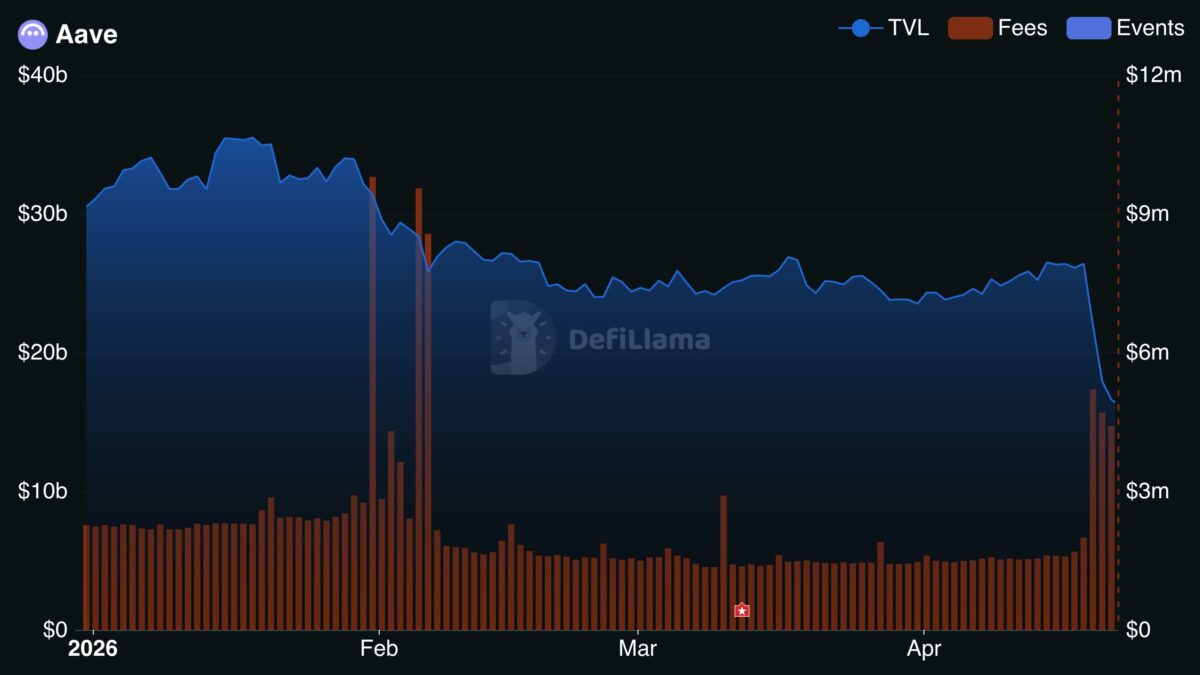
Governance and risk teams at Aave rallied: the Protocol Guardian froze all rsETH and wrsETH reserves across V3 and V4 on Ethereum and several L2s, slamming loan-to-value (LTV) back to zero. The bleed was checked, but suppliers found themselves momentarily locked, and the entire debate about collateral risk models in an era of ultra-composable LRTs flared up with the heat of a thousand keyboards.
The Centralization Reckoning: Arbitrum’s Security Council Steps In
As funds sloshed across chains, Arbitrum’s Security Council-an elected body with emergency powers-took action on April 21. With an atomic upgrade to the inbox contract, they froze 30,766 ETH (about $71 million) tied to the exploiter on Arbitrum One and moved it to a governance-controlled wallet pending DAO approval.
Some applauded this as prudent stewardship that curtailed laundering activity, especially against a Lazarus-linked actor. Others railed that even mature L2s are, at heart, multisig-governed. The chatter between Justin Sun and others comparing Arbitrum’s swift intervention with Tron’s “decentralization” rhetoric turned into a broader philosophical squabble: when does emergency action slide into centralized control?
The Stablecoin Hammer Drops: $344 Million USDT Frozen on Tron (April 23)
The crescendo arrived on April 23 as Tether, in concert with U.S. law enforcement and OFAC, blacklisted and froze $344 million USDT across two Tron wallets-one around $213 million and the other about $131 million. The addresses were linked to illicit activity and sanctions evasion. It stood as one of Tether’s largest single enforcement actions and underscored how regulatory pressure tightens its grip during a period of operational mayhem.
A Parallel Warning: The eth.limo DNS Hijack (April 18)
While rsETH sang its disastrous aria, another cautionary tale emerged from the off-chain side of Web3. The eth.limo ENS gateway-an open-source service that translates ENS domains into HTTPS URLs via IPFS and other decentralized storage-was domain-hijacked.
Attackers employed social engineering to impersonate an eth.limo team member and persuaded the registrar EasyDNS to start an account recovery. They briefly seized control, altered nameservers (shifting to Cloudflare and later Namecheap), and could have redirected traffic from wildcard *.eth.limo domains-including Vitalik.eth.limo-to phishing pages or malware.
Vitalik Buterin himself warned users to avoid all eth.limo URLs and instead use direct IPFS links. DNSSEC protections helped stymie the damage, and the domain was recovered within hours. No major fund losses were reported, but the incident laid bare how centralized DNS dependencies and social-engineering vectors can threaten the accessibility of decentralized websites.
The eth.limo hijack, occurring on the same day as the rsETH exploits, served as a crisp reminder that DeFi’s soft underbelly extends beyond smart contracts. Front ends, DNS, and operational practices can bite just as hard as any bug in code.
Why This Month Was Different: Systemic Lessons from the Cascade
April 2026 exposed three structural frailties that no amount of code review can fully banish:
- Bridge Fragility and Single Points of Failure: From Hyperbridge’s MMR bypass to a lone DVN verifier at LayerZero, cross-chain messaging remains a tempting target. LRTs promise slick liquidity, but they also invite spectacular mischief when the plumbing is fragile.
- Composability Risks with LRTs: Liquid restaking tokens like rsETH can be a dream for yield seekers until the supply goes unbacked and floods lending markets, turning “over-collateralized” into “overconfidently insolvent.”
- State-Sponsored Professionalization: Lazarus Group’s involvement in both Drift and rsETH showcases a new kind of adversary-patient, well-funded, and brutally methodical. Estimates place the group’s historical loot in the billions, with April adding hundreds of millions to the North Korean treasury.
Protocols That Hit Pause and the Road to Recovery
Beyond the headline acts, several protocols paused or froze operations: Kelp DAO across chains, SparkLend, Fluid, Upshift, and smaller players caught in the rsETH contagion. Aave’s Umbrella module and governance proposals for handling bad debt became urgent chatter in the virtual water cooler. Kelp DAO faced pressure to socialize losses or backstop rsETH holders, which is a phrase that sounds far more comforting in a meeting than in reality.
Recovery remains uncertain. Funds laundered through mixers or bridges may be stubbornly difficult to reclaim, especially from Lazarus-linked wallets. Insurance protocols and on-chain coverage will likely see a fresh flood of interest.
Forward Outlook: Maturity or Mass Exodus?
Black April compels a reckoning. DeFi builders should heed the call for MPC wallets, more diverse verifiers, ZK-based bridging, less over-cannibalization of liquidity, and clearer rules for socializing losses. Regulators will probably point to these events as justification for tighter oversight on bridges and stablecoins.
Yet the optimistic case endures: crises can accelerate maturity. The survivors who recover openly and transparently will rebuild trust. Capital may drift toward more conservative tokenized real-world assets (RWAs), but the core magic of permissionless finance persists.
For users and protocols alike, the takeaway is plain: brace for composability risk, verify governance assumptions, and never underestimate the audacity of state-level adversaries. April 2026 wasn’t the end of DeFi-it was the loudest, most melodramatic wake-up call yet that security, decentralization, and usability must evolve together.
Read More
- Silver Rate Forecast
- Gold Rate Forecast
- Brent Oil Forecast
- USD ARS PREDICTION
- USD JPY PREDICTION
- CNY JPY PREDICTION
- USD BRL PREDICTION
- ETH PREDICTION. ETH cryptocurrency
- SpaceX IPO Could Trigger Billions in Forced Buying Under Nasdaq’s New Rules
- EUR USD PREDICTION
2026-04-24 22:28