Key Highlights
- World Liberty Finance (WLFI) has publicly threatened legal action against Justin Sun following his April 12 allegations that the protocol embedded a hidden blacklist function used to freeze his ~$70M token holdings.
- The project’s treasury borrowed roughly $75M in stablecoins against 5 billion WLFI tokens on Dolomite, where it now controls more than half of all supplied assets.
- Sun is demanding public disclosure of the single guardian wallet and 3-of-5 multisig that retain unilateral freeze authority over user tokens.
The disagreement between World Liberty Financial, which has ties to Donald Trump, and Tron creator Justin Sun has become a public legal battle. This happened after Sun accused World Liberty Financial of secretly adding a feature to its contracts that would allow them to freeze tokens, following his $30 million investment.
On April 12th, WLFI responded to a post on X (formerly Twitter) with a four-line statement that ended with a dismissive “See you in court.” Shortly after, Sun requested that the project reveal the owners of the digital wallets with the power to freeze users’ tokens, and he repeated this demand with greater emphasis the following day.
The recent conflict has caused WLFI’s token value to drop to a record low, and it’s raised doubts about whether the platform is truly decentralized as it claims.
Is anyone still trusting Justin Sun? He consistently deflects from his own wrongdoing by claiming to be the victim and making unsupported accusations. This isn’t the first time he’s used this tactic – WLFI is just the latest example. We possess the contracts, the evidence, and the truth to prove it.
— WLFI (@worldlibertyfi) April 12, 2026
Sun, who put in around $30 million and acted as an advisor, quickly reacted by asking the anonymous team to reveal their identity and criticizing WLFI for seemingly exploiting the community. The following day, he insisted on complete transparency, requesting the public identification of the main account controlling the tokens and the group of people who could freeze them at any time.
The situation couldn’t have come at a worse time. WLFI recently used about 5 billion of its own tokens as collateral to borrow $75 million in stablecoins, and this action contributed to a sharp 15% drop in the token’s price, hitting a new low of around $0.08. Now, the WLFI community is extremely worried about the possibility of the collateral being liquidated, potential conflicts of interest, and the project being too centrally controlled, and these concerns are being widely discussed on platforms like X, Reddit, and the WLFI governance forum.
Here’s a comprehensive look at the conflict between WLFI and Justin Sun, including a detailed timeline of events, on-chain data, potential issues with the token’s economics, and what it all means for those invested in PolitiFi projects.
What is World Liberty Financial (WLFI)?
As a researcher, I’ve been investigating World Liberty Financial, a new DeFi protocol that launched in 2024. My findings reveal a significant connection to the family of former U.S. President Donald Trump. Public records indicate they’re receiving a substantial portion – up to 75% – of the profits from specific token sales, despite having a limited role in the day-to-day operations of the protocol.
This project includes a platform for borrowing and lending, its own USD-backed stablecoin, and a way to earn rewards by staking. It also intends to expand into foreign exchange trading.
As of April 14th, WLFI is trading around $0.08, which is down about 82% from its high of $0.46 in September 2025. Currently, 31.76 billion WLFI tokens are in circulation out of a possible 100 billion, giving the token a market value of approximately $2.54 billion. If all tokens were in circulation, the total value would be around $8.02 billion.
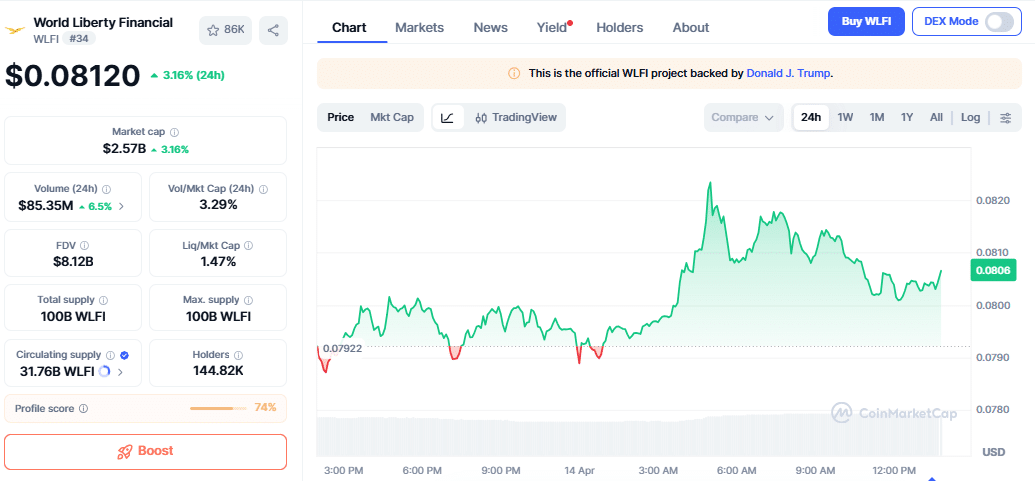
Recent events have caused trading volume to jump to around $86 million in the last day. The project’s stablecoin, valued at one US dollar, currently has over $4.08 billion worth in circulation.
The project began offering loans using Dolomite in January 2026 and updated its staking system the following month to reward those who held assets for longer periods. However, some people are now claiming that the project isn’t actually decentralized, pointing to anonymous control over key functions and movements of funds.
The Justin Sun Fallout: From $30M+ Investor to “Trap Door” Victim
On November 26, 2024, Justin Sun invested approximately $30 million in WLFI and became a major outside investor and advisor. However, in September 2025, WLFI blocked his digital wallet, effectively freezing 545 to 595 million WLFI tokens – worth around $107 million at the time. Sun alleges that the WLFI project secretly added features allowing them to blacklist wallets and reallocate tokens through updates released in August and November 2025, after he had already invested.
Until recently, Sun was a major supporter of WLFI, making one of the project’s largest single investments in November 2024. He then became an advisor and consistently promoted WLFI on social media. However, the project froze his account in September 2025, claiming it was a security measure related to suspected misuse of funds, effectively ending their partnership.
On April 12th, Sun posted that the system included a hidden function allowing insiders to freeze accounts without warning, justification, or any way to appeal the decision. They described it as a deceptive practice, appearing open but actually functioning as a trap.
On April 13th, he demanded that World Liberty Financial reveal who controls the main account and the multi-signature system, explaining that a single person currently has the power to freeze anyone’s funds.
WLFI responded with a brief and hostile statement, accusing Justin of portraying himself as a victim and stating they would address the matter in court.
The $75M Dolomite Borrow: Self-Dealing or Smart Treasury Move?
Shortly before the issues became public, WLFI transferred 5 billion WLFI tokens (worth approximately $440–460 million at the time) to Dolomite and then borrowed around $75 million in stablecoins (including over $65 million in USD1 and USDC). More than $40 million of these funds were then sent to Coinbase Prime. As a result, WLFI now controls over half of the total assets held by Dolomite.
The community reacted quickly to the news with a 15% drop in price, concerns about potential liquidations, and claims of unfair practices involving collateral. WLFI responded by assuring everyone they are not close to liquidation and are prepared to add more collateral if necessary. They also pointed to $6.558 million in token buybacks and $1 million in revenue as signs of financial health.
The main issue is simple: WLFI is a token that isn’t traded very often, and using 5 billion of these tokens as collateral to create $75 million in stablecoins is risky. If the value of WLFI drops, automatic sales triggered on Dolomite could flood a market with few buyers, potentially causing the price to fall even further.
Now that WLFI represents over half of the assets on Dolomite, the individuals lending to it are essentially backing the Treasury’s investment. The team behind WLFI has promised to add more collateral if the price drops, but this relies completely on their ongoing commitment and capability to follow through.
Full WLFI Drama Timeline (2024–2026)
| Date | Event | Market Impact |
|---|---|---|
| Nov 26, 2024 | Justin Sun invests over $30M and joins as an advisor | Massive hype |
| Aug–Nov 2025 | Smart contract upgrades introduce blacklist and batch-reallocation functions | Sun’s wallet frozen (Sep 2025) |
| Sep 2025 | Sun’s 595M tokens blacklisted (~$107M value at time) | Trust erosion begins |
| Jan 2026 | Dolomite lending markets launch for USD1 | Stablecoin growth |
| Feb 2026 | Staking overhaul + forex platform tease | Mixed governance sentiment |
| Apr 9–10, 2026 | Treasury deposits 5B WLFI, borrows $75M on Dolomite | 15% crash to ATL |
| Apr 12, 2026 | Sun’s “trap door” thread; WLFI “See you in court pal” | Volume explodes |
| Apr 13, 2026 | Sun demands EOA/multisig disclosure | Legal war escalates |
WLFI Controversy vs. Community Sentiment
| Issue | Justin Sun’s Stance | WLFI Team’s Defense | Community / DeFi Analyst View |
|---|---|---|---|
| Token Freeze | Hidden “trap door” used to confiscate tokens illegitimately. | Necessary security measure; Sun’s wallet was flagged for misappropriation. | Skeptical of centralized backdoors in supposed DeFi protocols. |
| Dolomite Loan | Points to it as further proof of team mismanagement. | “Nowhere near liquidation.” Highlights $159.5M annualized USD1 revenue. | Highly dangerous. Illiquid tokens used to extract hard cash by insiders. |
| Governance | Rigged votes orchestrated to benefit the founders. | Community-driven votes to protect the ecosystem. | Governance is an illusion; insiders hold majority control. |
Fact-Checking the Drama
Claim: Dolomite lenders have lost their funds.
False.
Dolomite is still functioning, and no positions have been closed due to insufficient funds. However, the platform has become riskier because most of its assets are now tied to the WLFI token. The team behind WLFI has said they’ll add more collateral if the token’s price drops further, but this depends on their commitment and whether they can actually follow through.
Claim: Justin Sun is suing Donald Trump.
False.
Sun has publicly reiterated his backing of President Trump and his views on cryptocurrency in recent posts on X (formerly Twitter) from April 12th and 13th. He’s aiming his accusations and legal warnings at the team behind the project – those responsible for its development and day-to-day operations – and not at the Trump family or the President himself.
Claim: The $75M Dolomite borrow was illegal.
False.
While some have criticized its design, borrowing against your own assets is common in the DeFi world and isn’t inherently illegal. The main issue isn’t about the legality, but rather a potential conflict of interest: WLFI used a relatively rare governance token to borrow $75 million in stablecoins from a platform where its advisor and CTO, Corey Caplan, also co-founded the company. Critics are concerned that WLFI’s large control over the platform’s assets, combined with this overlap, creates a governance problem and potential conflict of interest.
Tokenomics & On-Chain Red Flags
- Supply: 100B total, only ~31.76% circulating. Sun claims his vesting category was uniquely altered.
- Buybacks: $6.558M spent repurchasing 43.5M tokens.
- Performance: –82% from ATH; drama has driven 3–5× volume but crushed holder confidence.
Blockchain data reveals that a single authorized account connected to the system’s security can independently halt operations, but seizing funds requires approval from at least three out of five authorized parties. Sun describes this setup as merely a performance of governance, rather than true decentralized control.
What to watch
So far, no lawsuits have been filed in court related to this issue, and it’s unknown where WLFI might take legal action. Right now, the biggest concerns are happening with the WLFI token itself: if the price drops further, a key financial position could be automatically closed, resulting in losses. Also, any actions taken with the main WLFI wallet – like freezing funds or moving money – will likely cause a strong negative reaction from the community.
Increased regulatory oversight is a likely future concern. Tokens linked to current politicians are already legally questionable, and the recent public disagreement between the project creators and an initial investor will likely attract even more attention from authorities.
Currently, the disagreement is just a back-and-forth of claims. Both sides insist they have the contracts and proof to support their position, but ultimately, only one will be shown to be correct.
Read More
- Brent Oil Forecast
- Silver Rate Forecast
- Gold Rate Forecast
- CNY JPY PREDICTION
- USD BRL PREDICTION
- ETH PREDICTION. ETH cryptocurrency
- USD CNY PREDICTION
- Lobsters, AI, and Crypto Chaos: OpenClaw’s Wild Takeover
- Crypto’s Latest Folly: $100K Sparked $50M USR Meltdown
- US Bankruptcy Explosion: 14% More Americans on the Edge!
2026-04-14 15:33