The crypto circus is officially in the “waiting room.” Bitcoin is stuck in a sad little range, while altcoins cling to life at underwhelming demand levels. Yet beneath all this tragic price action, a fresh report from CryptoQuant Research has unraveled Q1 2026 exchange data that presents an entirely different view of this so-called “consolidation.”
The headline? Brace yourself: centralized exchange trading volume plummeted by a spectacular 48%, from the October 2025 zenith, all the way down to a paltry $4.3 trillion in March 2026. Yes, you read that right-$4.3 trillion, which is the lowest since October 2024. This isn’t your usual seasonal dip. It’s a near-halving of market participation in just five months. The overenthusiastic speculators who fueled the last peak are now sipping cocktails in some distant beach paradise, leaving behind a market void of anything remotely resembling vigor.
Now, what’s left? Oh, just a grand reveal of market dynamics. Out of the $4.3 trillion in March volume, a staggering $3.5 trillion was tied to perpetual futures-a mere $0.8 trillion was attributed to actual spot markets. So, no, this isn’t driven by some noble holders buying and selling real assets. It’s a game of leveraged traders making bets on where the market might go next, all while using synthetic tools to play pretend with price direction.
The math doesn’t lie. For every one dollar of real spot demand, there’s four dollars of derivative noise. A healthy market? No, it’s the unmistakable fingerprint of a market on the edge-waiting for demand to kick in and make all that leverage actually mean something.
The Crypto Market Shrank
Now here’s where it gets delightfully absurd. While total exchange volume hemorrhaged nearly 50%, Binance just casually waltzed through March with $248 billion in spot trading. This translates to roughly 32% of the market share in 2026, equating to about $1 trillion in cumulative volume. How’s that for making your competitors look like amateurs? MEXC, trailing behind, holds a mere 9%, while Bybit clocks in at a pitiful 7%. Binance’s lead is a monolith that makes everyone else look like they’re playing marbles in a sandbox.

The decline from 37% market share in October 2025 to a measly 32% now? Well, it’s not a sign that Binance is slipping. No, no, it’s just that some of the secondary exchanges are finally starting to gain a bit of traction. MEXC, Bybit, Gate, Crypto.com-all of them have increased their spot volumes in this slowdown, but none are remotely close to the behemoth that is Binance. Competition is increasing, but consolidation of power? Not yet.
The derivatives side of the story only deepens this narrative. Binance leads the perpetual futures pack with a jaw-dropping $1.4 trillion in monthly volume and a 40% market share. To put that in perspective, OKX holds just 19%, while Bybit is trailing behind with a pathetic 13%. In 2026, derivatives have been the true fuel behind the exchange industry’s entire growth engine.
The Q1 data paints a picture of a market where overall participation has dwindled, but the concentration of remaining participants has grown even more intense. The money will return, as it always does-history tells us that. And when it does, it’s going to favor those who managed to hold their ground. Binance? Well, they’re sitting pretty, ready for the flood when it arrives.
Total Market Cap Enters Transitional Range After Breakdown
Here comes the transition, folks. The total crypto market cap is no longer a sprint-it’s a meandering walk in the park. After peaking near the $3.8T-$4.0T zone in late 2025, the market broke down and slid toward the $2.1T-$2.2T range, signaling a shift from expansion to pure distribution.
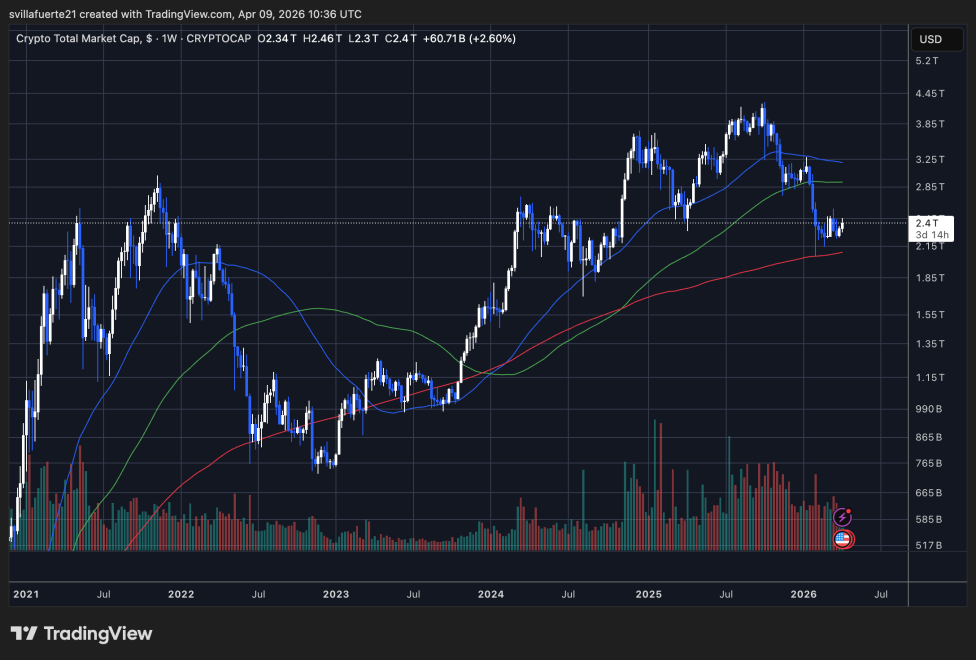
Since then, the price has found a somewhat stable home between $2.3T and $2.4T. But don’t get too cozy. The technical indicators-those pesky moving averages-are telling us that momentum is fading. The market’s trading below both the 50-week and 100-week moving averages, and they’re either flattening or descending. Translation: don’t expect any fireworks just yet.
The 200-week moving average (red line) is acting as support, holding steady near $2.0T. It’s the lower bound of this cycle, unless some macroeconomic catastrophe rears its ugly head. But don’t get your hopes up for a glorious recovery-market activity has dropped right alongside prices, which suggests people aren’t exactly rushing to buy up crypto like they did last year.
In summary, we’re in a re-accumulation or redistribution phase. For a true bullish breakout, we’ll need to reclaim the $2.8T-$3.0T range. Until then, we’re stuck in a sort of neutral-to-bearish limbo, waiting for something, anything, to break the cycle.
Read More
- Brent Oil Forecast
- Gold Rate Forecast
- Silver Rate Forecast
- USD BRL PREDICTION
- TIA PREDICTION. TIA cryptocurrency
- NEAR PREDICTION. NEAR cryptocurrency
- 5 Crypto Firms That Secured a Whopping $10 Billion in Q2: A Tale of Bitcoin, Blockchain, and Bold Ventures
- Ex-Coinbase Counsel Dives Into Politics: Will Crypto Crusader Shake Up NY?
- Trump’s TACO Trade: A Culinary Disaster in the Markets
- METH PREDICTION. METH cryptocurrency
2026-04-10 01:42