As a researcher tracking the cryptocurrency market, I’ve observed Bitcoin (BTC) recently hit $72,000 following news of a two-week ceasefire between the US and Iran. However, my analysis of options data suggests this price increase isn’t necessarily due to new investors buying in, but rather a relief rally as existing concerns eased. In other words, people are less fearful, which is driving the price up, not necessarily a surge of new optimism.
The announcement of a ceasefire was made with help from Pakistan at the same time that $2.18 billion worth of Bitcoin and Ethereum options contracts are set to expire on Friday. Representatives from both Washington and Tehran are also scheduled to meet in Islamabad that same day to continue talks.
Ceasefire Sends Shockwaves Through Markets
Following talks led by Pakistan’s Prime Minister Shehbaz Sharif and Field Marshal Asim Munir, President Donald Trump agreed to temporarily halt planned military actions against Iran. Trump described Iran’s ten-point plan as a potential starting point for achieving lasting peace.
I am very pleased to announce that Iran, the United States, and our respective allies have reached an agreement for an immediate ceasefire in all areas of conflict, including Lebanon. This ceasefire takes effect right away. I extend a warm welcome to this…
— Shehbaz Sharif (@CMShehbaz) April 7, 2026
Global markets reacted quickly to the changing political situation. The price of West Texas Intermediate crude oil dropped as much as 19%, while S&P 500 futures increased by over 2%. Bitcoin, acting like a risky investment, jumped from around $69,000 to $72,000 in just a few hours.
Iran announced it will guarantee safe passage for ships through the Strait of Hormuz for the next two weeks.
Israel’s Prime Minister’s Office backed the suspension, though the truce excludes Lebanon.
The Prime Minister’s Office stated that Israel backs President Trump’s choice to pause military action against Iran for two weeks, provided Iran immediately reopens shipping lanes and ceases all attacks on the US, Israel, and other nations in the area.
— Prime Minister of Israel (@IsraeliPM) April 8, 2026
Options Data Tells a Different Story
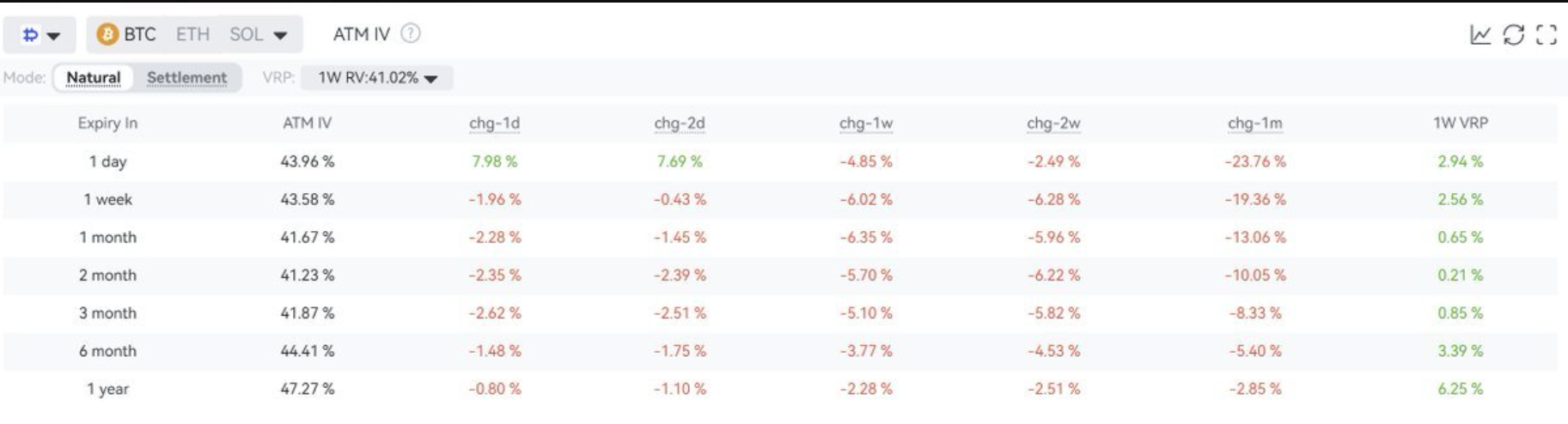
Even though Bitcoin’s price went up, analysts at Greeks.live noticed something unusual in the options market. While Bitcoin itself was increasing in value, the expected volatility of options contracts was actually going down, suggesting a mismatch between current prices and future expectations.
Near-term IV also fell, while 1-day IV spiked 7.98% to 43.96%, capturing only the immediate move.
The tendency for extreme negative price movements decreased as the market gained ground, lessening the need for insurance against sudden drops. However, the difference between expected and actual volatility shrank because actual market swings increased to 41.02%, while expected swings didn’t keep pace.
The price of Bitcoin going back above $70,000 has improved how people feel about the market, mainly because it’s eased worries about a sudden, unexpected crash, not because people necessarily expect prices to keep going up.
When futures prices decrease while the current price of a commodity increases, it’s a classic volatility crush. Traders are closing positions they opened to protect against a potential conflict with Iran, rather than making new investments expecting prices to go up.
Friday’s Dual Catalyst
Deribit will see $1.87 billion in Bitcoin options and $310 million in Ethereum options expire on April 10th. Also on that day, Sharif has extended invitations to both delegations to travel to Islamabad to continue working towards a final agreement.
If the current peace continues or leads to a larger agreement, we can expect prices to stabilize further. However, if negotiations fall apart, recent gains could quickly disappear.
Iran’s plan to charge ships $2 million to pass through the Strait of Hormuz could bring in $100 billion each year and potentially reshape the balance of power in the region.
Just a quick thought before I head to bed: It seems Iran effectively won the recent conflict. The ceasefire agreement gives them control over the Strait of Hormuz, and they’re reportedly charging $2 million per ship, which adds up to around $100 billion a year. That’s a huge amount of money! Plus, the details of the ceasefire itself…
— Mario Nawfal (@MarioNawfal) April 8, 2026
The market currently shows cautious pricing, rather than strong confidence. Friday will be a key test to see if the recent Islamabad talks and options expiration date combine to create a stable trend for the latter half of April, or if they will instead lead to increased market volatility.
Read More
- USD RUB PREDICTION
- USD JPY PREDICTION
- USD AUD PREDICTION
- EUR CNY PREDICTION
- Gold Rate Forecast
- Hong Kong’s Strict Stablecoin Rules: Only 2 Licenses Out of 36 Applications Approved!
- AAVE PREDICTION. AAVE cryptocurrency
- XLM PREDICTION. XLM cryptocurrency
- SOL PREDICTION. SOL cryptocurrency
- USD CNY PREDICTION
2026-04-08 08:36