It seems that Bitcoin, in all its ambition to shake off the shackles of traditional stocks, is still playing the same game as the S&P 500. While it may no longer be moving in perfect step with the S&P 500 over short periods, don’t be fooled into thinking it has found its true freedom just yet. As Axel Adler Jr. sagely points out in his latest brief, the real issue is not the temporary divergence between Bitcoin and the S&P, but rather its persistent underperformance against U.S. equities.
Bitcoin’s Struggle to Keep Up with the S&P 500
Adler’s argument is supported by two charts, which, when examined together, seem to dispel the increasingly popular narrative that a lower BTC-equity correlation means Bitcoin is heading off in its own direction. The first of these charts tracks the 13-week BTC-S&P correlation, which has recently turned negative and has stayed that way. On first glance, this might appear to be a victory for Bitcoin, but, as Adler explains, it’s all too easy to misinterpret such data.
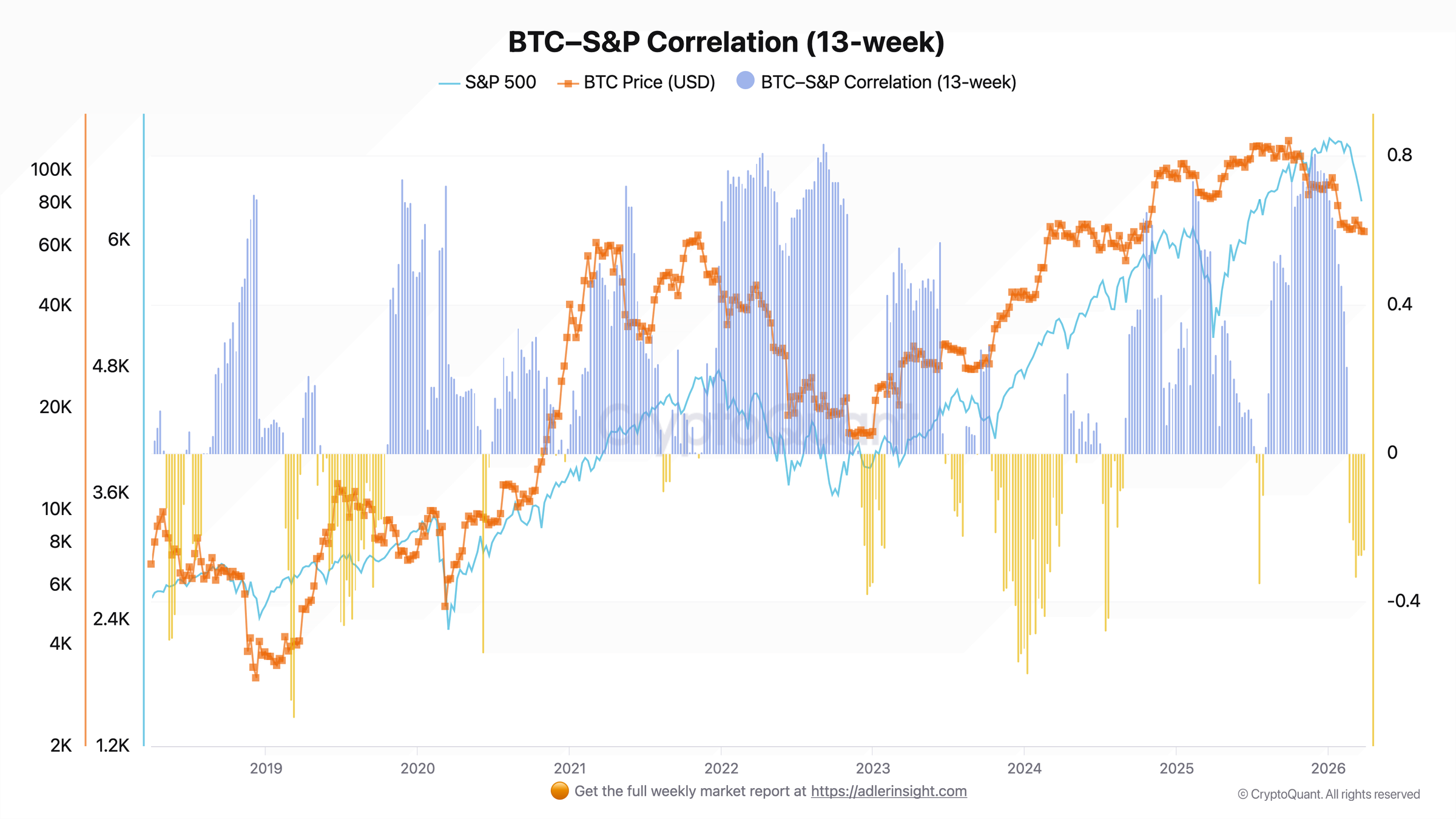
“The 13-week correlation measures how closely the weekly returns of BTC and the S&P 500 have moved together over a short window,” Adler writes. “Over the past few weeks, this short-term correlation has turned negative and stayed there. At first glance, this might seem like a loosening of the bond between Bitcoin and equities, but in practice, it more likely reflects the erratic nature of recent weeks, with Bitcoin bouncing up and down while the S&P trudges on in its weak state.”
This distinction, though subtle, is crucial. A falling or negative correlation only indicates that the two assets no longer move in perfect harmony. It does not mean Bitcoin is flourishing. It does not suggest that capital views Bitcoin as some sort of safe haven. And it certainly does not confirm that the market is treating Bitcoin as an independent force, unaffected by the same broader market pressures that are dragging down stocks.
For those hoping for the dawn of a Bitcoin renaissance, Adler points to the second chart: the BTC/S&P price ratio. Here is where the dream of decoupling crashes down. The ratio, which tracks Bitcoin’s performance relative to the S&P 500, has been steadily declining since the beginning of the year, showing no signs of recovery. Simply put, Bitcoin has been lagging behind stocks, even during periods when the short-term correlation has weakened.
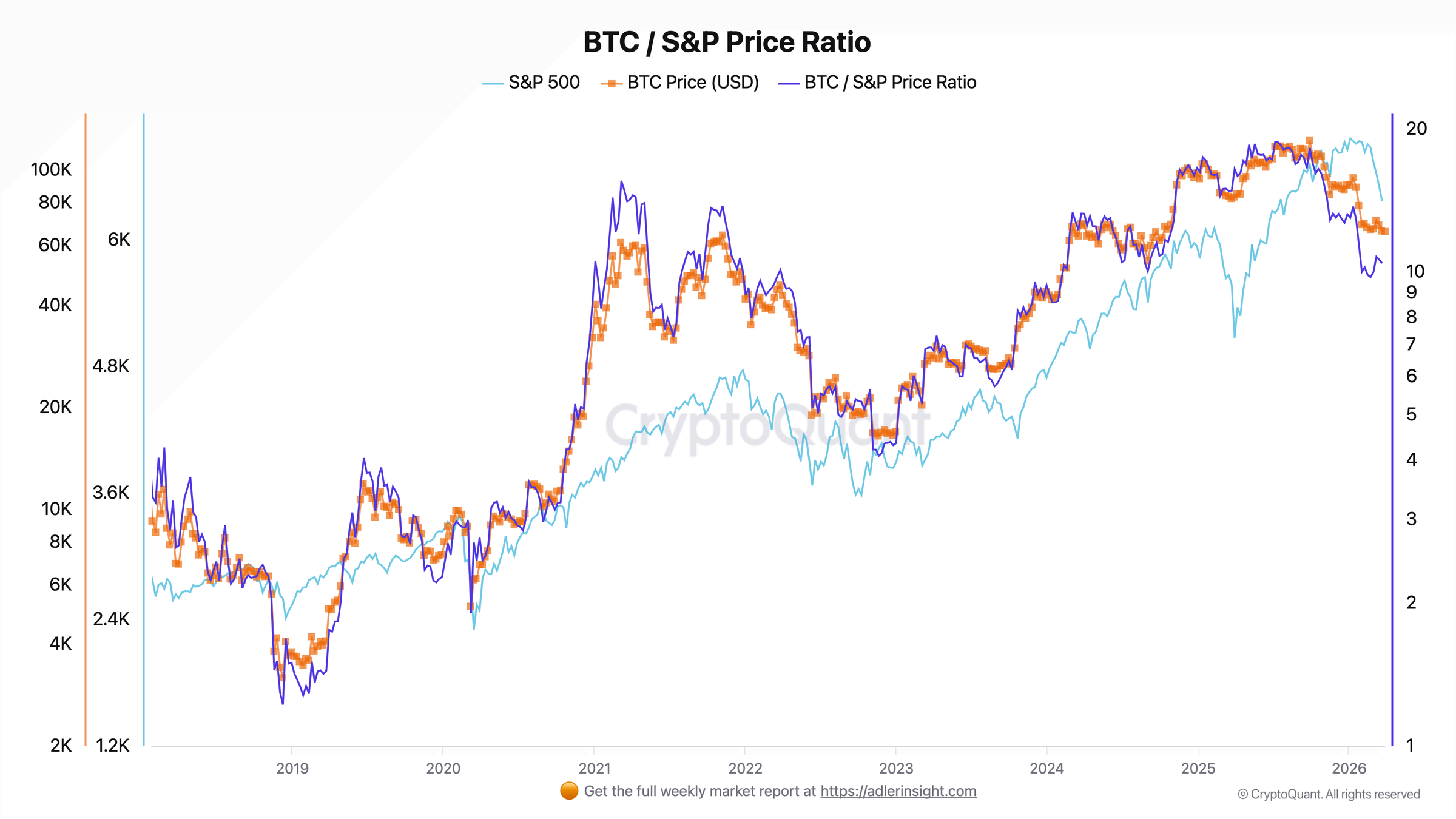
“What truly matters to the market here is not the mere fact of negative correlation, but whether this is accompanied by Bitcoin outperforming the S&P 500,” Adler explains. “And as of now, that confirmation is absent, making it far too early to proclaim Bitcoin’s independence from the risk-off regime.”
In this light, Adler urges a shift in focus from a single statistical measure to actual market behavior. If Bitcoin were truly decoupling, we would expect to see it strengthening relative to equities. Instead, Adler argues, the market continues to see Bitcoin as a higher-beta risk asset – one that is more prone to larger drawdowns than the S&P 500.
And Adler isn’t shy about spelling it out in his conclusion. “The market is sending an uncomfortable but, frankly, rather honest signal,” he writes. “The S&P 500 continues to decline, and Bitcoin is not merely holding its ground; it is continuing to underperform the index. The prevailing regime, therefore, remains decidedly risk-off.”
In this context, the key trigger to watch is not whether the correlation remains negative for yet another week, but whether the BTC/S&P ratio can reverse and show sustained outperformance. As Adler concludes, only a “new stable regime” of relative outperformance would lend credence to the decoupling theory. Until then, the market’s message remains clear: while the relationship between Bitcoin and equities may have become less predictable, it is by no means less sensitive to risk.
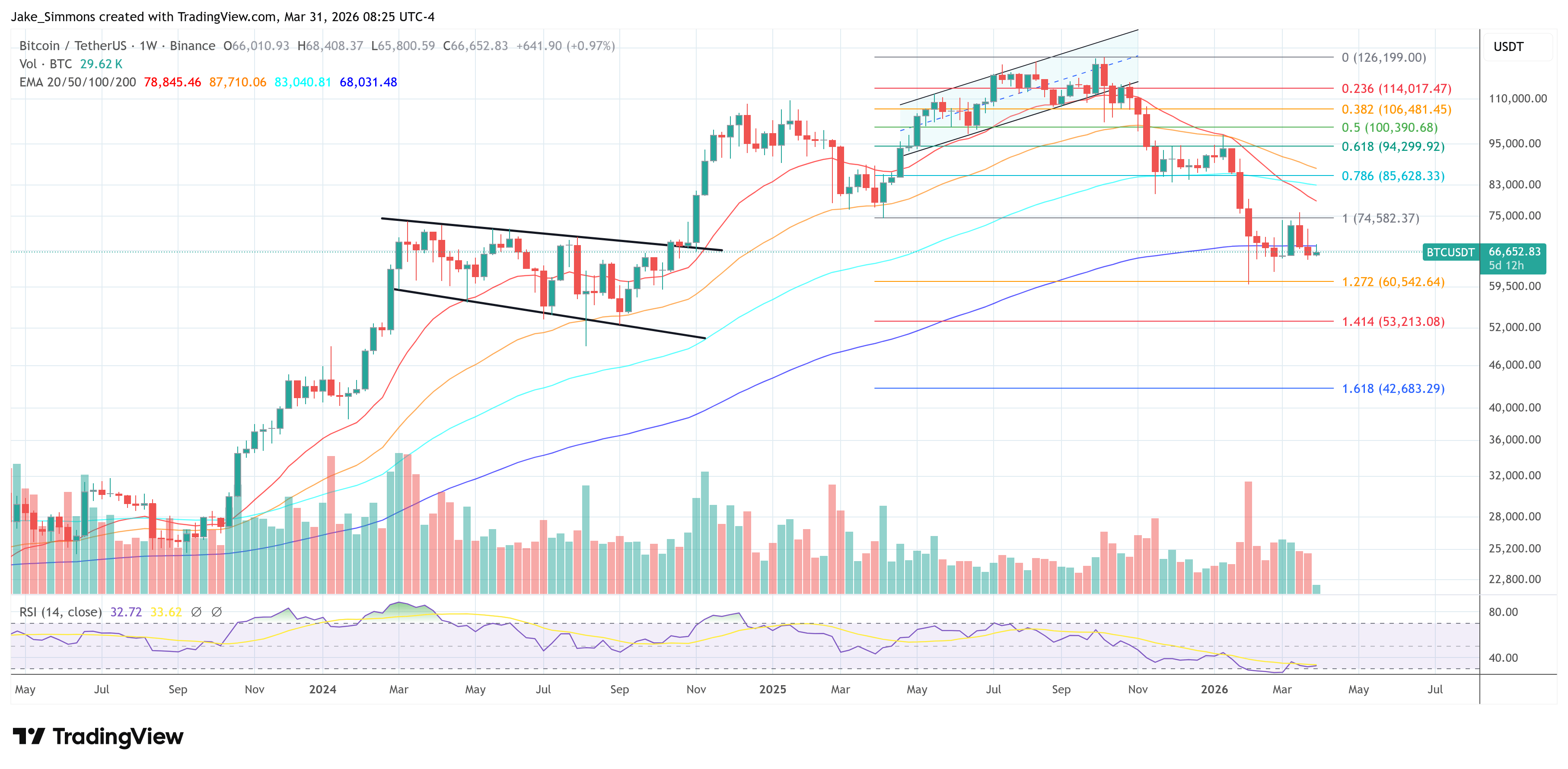
At press time, Bitcoin was trading at $66,652.
Read More
- USD TRY PREDICTION
- CNY JPY PREDICTION
- USD JPY PREDICTION
- USD HKD PREDICTION
- Brent Oil Forecast
- USD CNY PREDICTION
- NEAR PREDICTION. NEAR cryptocurrency
- Ethereum to $24K? Jolly Good Show, What?
- BCH PREDICTION. BCH cryptocurrency
- FIL PREDICTION. FIL cryptocurrency
2026-03-31 23:28