Dave Weisberger, the former CEO of CoinRoutes, recently suggested on X (formerly Twitter) that the increase in Bitcoin’s processing power (hashrate) expected around early 2026 isn’t just a typical recovery in the mining industry. He believes it could be an indication that Bitcoin’s price is about to rise. Weisberger’s main idea is that government-related mining operations are starting to influence Bitcoin in a similar way that central bank purchases of gold historically boosted its price before significant increases.
Weisberger explains the current gold market by looking at past gold cycles. He argues that central banks started buying gold years before prices went up, and this buying was the most important indicator. It wasn’t demand from investors or ETFs that mattered most, but rather central banks increasing their gold reserves due to growing global instability and concerns about traditional currencies.
The outcome has been a surprisingly strong rise in gold prices. Gold has reached record levels, exceeding $5,000 per ounce in this current market cycle, which caught many people off guard. Demand for gold increased first, and the price increases followed as the market reacted.
Why Bitcoin’s Hashrate Recovery Is Signalling The Next Rally
According to Weisberger, Bitcoin’s network hashrate experienced a classic V-shaped recovery in early 2026. After falling around 15-20% from its highest point, the network’s computing power quickly bounced back, rising from below 900 EH/s to over 1 ZH/s. This recovery was also marked by a significant increase in mining difficulty – almost 15%, one of the largest ever recorded.
According to Weisberger, the recent recovery in the market isn’t simply a bounce back from the difficulties of winter, regional outages, and reduced profits after the halving event. He believes it signals a change in who’s doing the mining. He explains, “This isn’t just random fluctuation; it’s a clear sign that national or government-backed mining operations are filling the gap where private miners were unwilling to act.”
A key point of the report is Weisberger’s assertion that at least 13 countries are now involved in Bitcoin mining, either directly or through state-backed entities, according to research from VanEck. He specifically mentions Bhutan, the UAE, and El Salvador, and also identifies Russia, Iran, and Ethiopia as nations using their energy resources for Bitcoin mining.
He explained that this isn’t about individual miners or even large companies trying to profit from cryptocurrency. Instead, it’s governments using excess or strategically important energy to create a secure, digital asset that can’t be easily taken or frozen. They’re doing this to generate revenue without printing more money, to help secure the network while directly benefiting, and to establish a position in a world where controlling their own finances is increasingly important.
Weisberger points out that government-owned miners have advantages over private miners. They can think long-term, have access to cheaper funding, and aren’t as compelled to sell Bitcoin when prices drop. This allows them to buy new Bitcoin directly and hold it for the long haul, which reduces the amount of selling pressure on the market and simultaneously helps to secure the Bitcoin network.
Weisberger points out that a rise in hashrate isn’t an immediate signal of recovery; it actually lags behind. This is because expanding sovereign mining operations takes time – it involves acquiring equipment, securing energy sources, building facilities, and getting necessary approvals. These steps happen gradually, frequently during times when the price of cryptocurrency seems stable or is declining.
From my analysis, we’re seeing a shift in Bitcoin’s fundamentals that could reshape the market *before* it’s fully reflected in the price. What I’m observing is increased network security, a more controlled release of new Bitcoin, and growing acceptance of it as a long-term store of value, moving beyond just a speculative asset. Frankly, I believe the recent recovery in Bitcoin’s hashrate – its processing power – is more than just a technical bounce. It’s a clear signal that governments are actively investing in the infrastructure and resources that support Bitcoin, essentially voting with their actions.
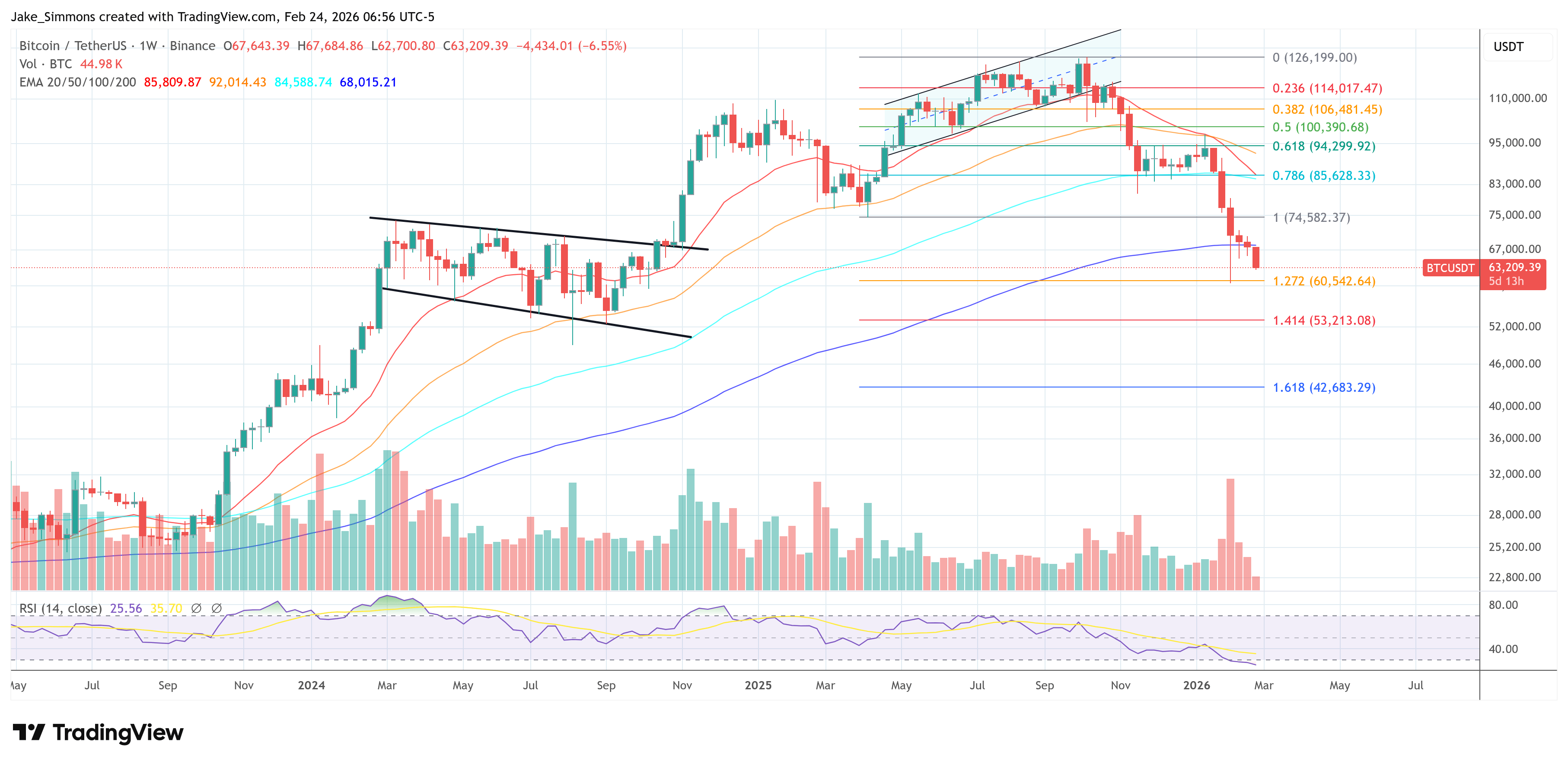
At press time, BTC traded at $63,209.
Read More
- Gold Rate Forecast
- Silver Rate Forecast
- Brent Oil Forecast
- USD ARS PREDICTION
- USD JPY PREDICTION
- USD BRL PREDICTION
- USD CNY PREDICTION
- ETH PREDICTION. ETH cryptocurrency
- SpaceX IPO Could Trigger Billions in Forced Buying Under Nasdaq’s New Rules
- CNY JPY PREDICTION
2026-02-25 04:17