The XRP Ledger (XRPL), that beleaguered beast of the blockchain world, has clawed its way to activate Permissioned Domains on February 4, 2026. Over 91% of validators, those digital gatekeepers of fate, have endorsed the XLS-80 amendment. A triumph? Perhaps. A farce? Well, let’s see.
The timing is as poetic as a dying star-XRP’s price has plummeted by double digits amid a market downturn so brutal it makes a bear market look like spring training. Now, as the network dons its new infrastructure armor, we’re left wondering: Will this upgrade be a knight in shimmering code or just another jester’s trick?
What are XRPL Permissioned Domains?
The XLS-80 proposal, written with the enthusiasm of a tax accountant at a rave, introduces Permissioned Domains. These are managed environments within XRPL where access and user activity are governed by rule-based credentials. Imagine a blockchain version of a velvet rope at a nightclub-only the bouncer is a line of code.
Instead of building private blockchains (a task as fun as watching paint dry), these domains operate as credential-gated access layers on the public XRPL. It’s like inviting guests to a party but making them wear name tags and pass a lie detector test before entering the snack table.
“This approach aims to bridge the gap between the transparency and security benefits of decentralized blockchain technology and the regulatory requirements of traditional financial institutions,” the proposal reads. Because nothing says “trust” like a document written in iambic pentameter.
Built on the XLS-70 Credentials framework, Permissioned Domains let domain owners define rules like a medieval king drafting decrees. Accounts with accepted credentials become members automatically-no handshakes, no small talk, just cold, algorithmic inclusion.
The proposal introduces new technical components, including the PermissionedDomain ledger object and management transactions like PermissionedDomainSet and PermissionedDomainDelete. It’s a symphony of bureaucracy, conducted by ones and zeros.
According to the proposal, this amendment is “foundational.” In other words, it’s the blockchain equivalent of laying the first brick in a pyramid-exciting in theory, but you won’t see results until the 10,000th brick.
Security risks are addressed with the grace of a bureaucrat explaining a budget cut. The model relies on trust in credential issuers and domain owners, which is charmingly naive given the current state of cybersecurity. Risks like compromised credentials or permissioned domains being used for “unlawful activity” are left to application and governance levels-because nothing says “security” like hoping everyone plays nice.
XLS-80 surged past the 80% validator threshold in late January, entering the standard two-week activation window. February 4 is now etched in the blockchain calendar like a date with destiny. Or, as some might call it, a Tuesday.

Permissioned Domains solve a core problem for financial institutions: meeting regulatory standards while pretending to innovate. Previously, they needed separate, isolated solutions-like trying to fit a square peg into a round hole with a sledgehammer. Now, they can use XRPL’s network within compliant zones, because nothing says “compliance” like a blockchain with a velvet rope.
“This means serious financial companies can now use the fast and cheap XRP network for their customers > while still following strict rules about who is allowed to participate – without having to build a completely separate blockchain. It’s basically adding ‘VIP rooms with security checks’ to an already existing public highway. Is this a key signal for someone like Swift?” an analyst wrote. Because nothing says “innovation” like a metaphor involving highways and velvet ropes.
Permissioned domains are the last piece of the puzzle. When financial institutions are able to create controlled environments, XRP will be unlocked. 04 Feb 2026 at 09:57:51 UTC
– Tony Valentino (@TonyVaI76476318) February 3, 2026
Will Permissioned Domains Impact XRP’s Price?
The rollout of Permissioned Domains strengthens XRPL’s utility and institutional appeal. Whether that translates into gains for XRP is like asking if a new coat of paint will fix a sinking ship. Doubtful.
XRP has dropped 16% in seven days, a performance that would make a falling piano look graceful. At press time, it was trading at $1.59, down 0.62% in 24 hours. A price so low, it’s practically giving away free coffee with every trade.
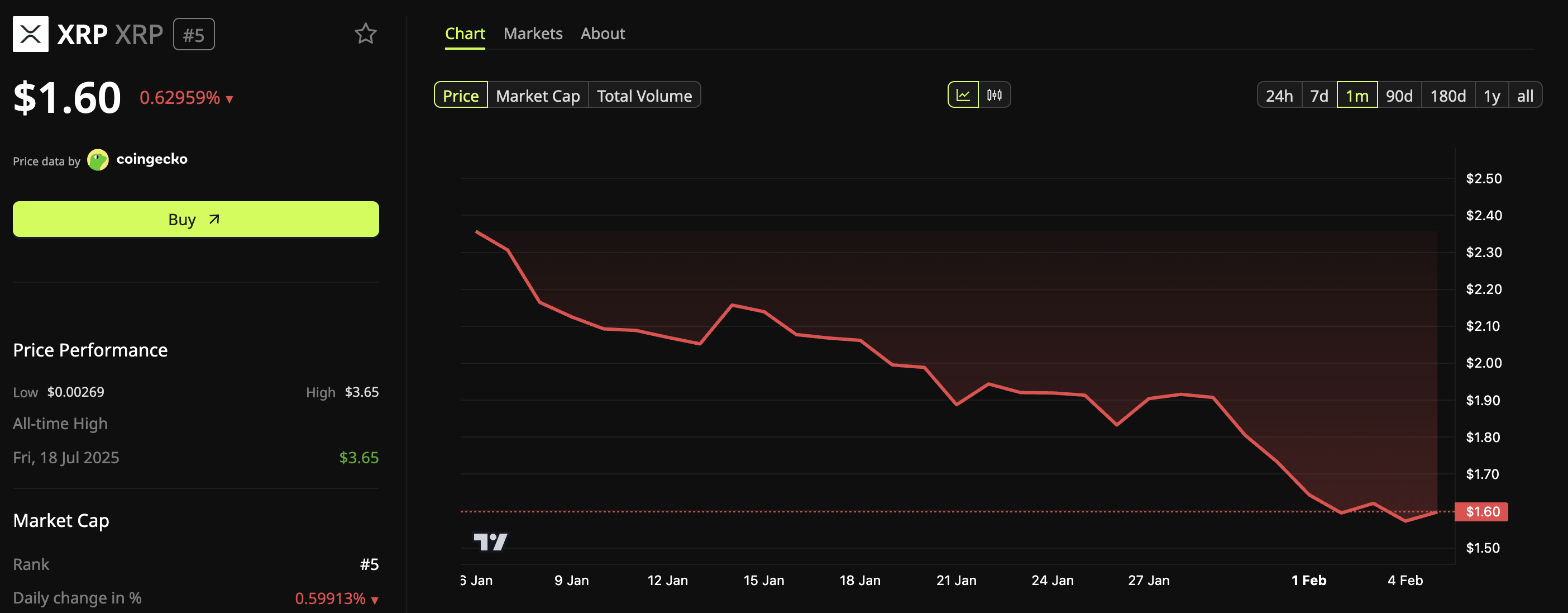
Despite the upgrade’s significance, Permissioned Domains are unlikely to act as an immediate catalyst for XRP’s price. The XLS-80 amendment doesn’t change XRP’s supply, fee structure, or demand dynamics. It’s like giving a car a new paint job but leaving the engine untouched.
The potential benefit for XRP may be indirect. If Permissioned Domains lead to real adoption-like permissioned decentralized exchanges or tokenized asset platforms-on-chain activity could rise. But until then, it’s a long-term bet, like waiting for a pot to boil while the kettle sings off-key.
In the end, the real test isn’t the code-it’s whether institutions follow through with deployments that actually drive activity. Until then, XRP’s future remains as certain as a politician’s promise.
Read More
- Gold Rate Forecast
- GBP USD PREDICTION
- USD ARS PREDICTION
- USD RUB PREDICTION
- ETH PREDICTION. ETH cryptocurrency
- Brent Oil Forecast
- FIL PREDICTION. FIL cryptocurrency
- USD ILS PREDICTION
- USD TRY PREDICTION
- Silver Rate Forecast
2026-02-04 08:37